
In the 1960s, Czechoslovakia attempted to create a more humane version of communism but ended up provoking a massive Soviet invasion. The Prague Spring began with hope and optimism and ended with arrests and foreign troops on the streets. What Hungary experienced in 1956, the Czechs got a taste of in 1968.
The result was growing revulsion among socialists for the Stalinist, bureaucratic and totalitarian model of Marxism. Some argued that the problem was inherent in Leninism while others believed that the fault lay entirely with Stalin. Regardless, the undeniable truth was that for millions of workers and students behind the Iron Curtain, Moscow’s version of communism was a nightmare.
Czechoslovakia should have been fertile ground for communists after the way the country was betrayed by the western powers in the 1930s – effectively handing Czechoslovakia over to the Nazis on a plate. Yet by 1968, any political advantage had been squandered by the repressive clique of communist apparatchiks.
Czech loss of confidence in the west
Czechs lost confidence in the western powers before the Second World War when, in 1938, Britain and France negotiated directly with Adolf Hitler handing sizeable parts of Czechoslovakia over to Germany. The Czech government was not invited to the talks, which resulted in the Munich Agreement.
In a supreme act of foolhardiness, Britain’s prime minister, Neville Chamberlain (1869-1940), returned home waving the agreement aloft and proclaiming “peace in our time”. Chamberlain, pictured below, completely misread Hitler. The British and French imagined they could appease the Nazi leader but predictably, he came back for more, swallowing the rest of Czechoslovakia in 1939.
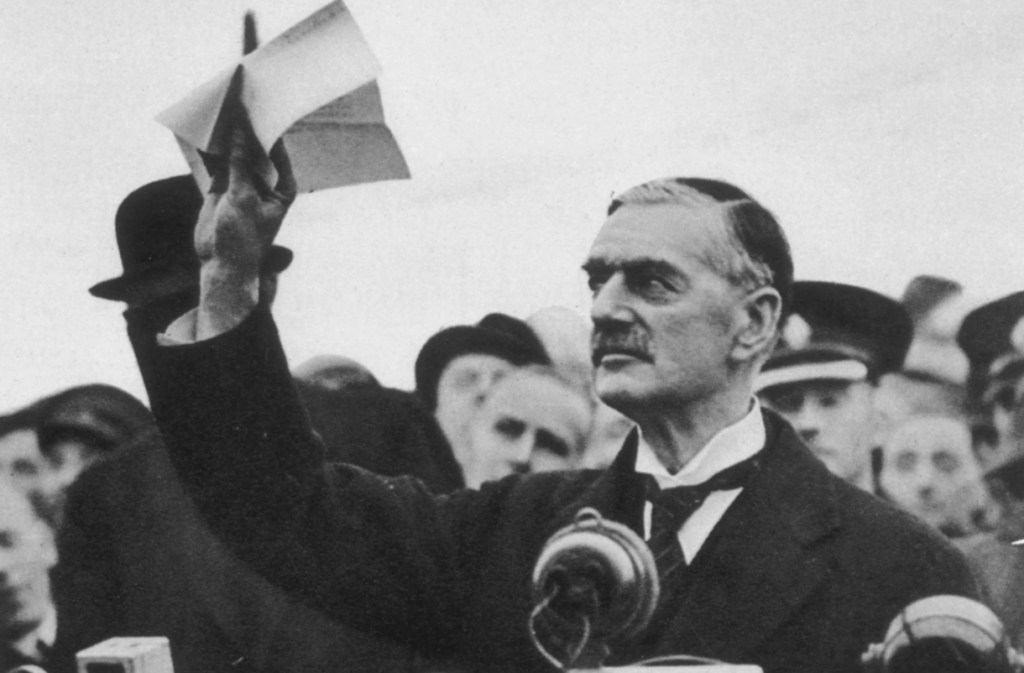
Immediately after Munich in 1938, the Czech president Edvard Beneš (1884-1948) resigned and, as the Nazis moved in to mop up the rest of Czechoslovakia, he fled to London – capital of the country that had betrayed him – to run a government-in-exile.
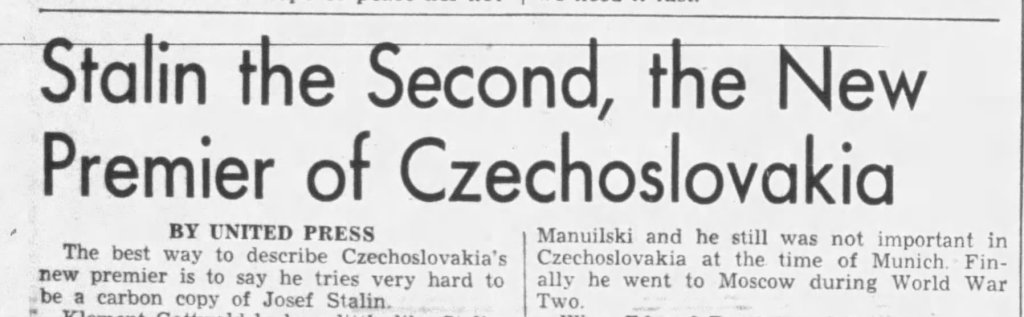
Beneš was unable to return to Czechoslovakia while the Nazis occupied his country. Once they were defeated, he faced the seemingly irresistible rise of the communists. The Communist Party of Czechoslovakia (Komunistická strana Československa, KSČ) was led by Klement Gottwald (1896-1953), described in one western newspaper report as a carbon copy of the Soviet leader, Joseph Stalin.
From coalition government to communist state
Nearly all the central and eastern European countries within the Soviet orbit of influence at the end of World War Two went through a brief phase of multi-party coalition government until their communist parties seized the moment to take complete control. So-called “salami tactics” were used to steadily eliminate the non-communist parties.
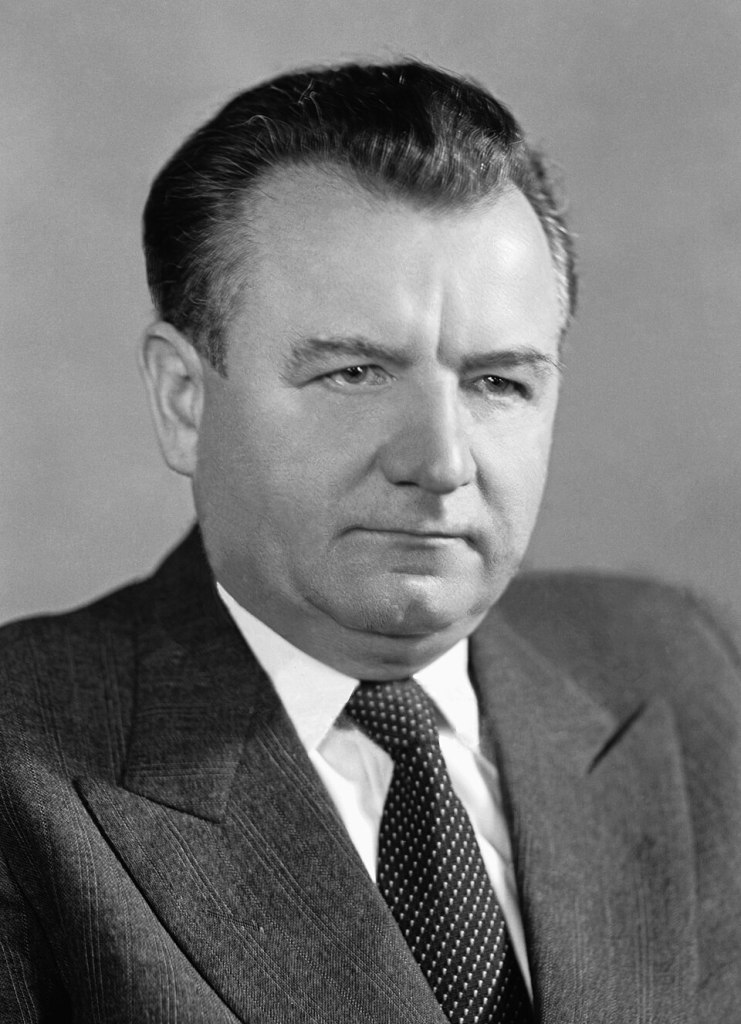
Czechoslovakia went through this process. From 1946 to 1948, Gottwald was prime minister while Beneš continued as president. Then in February 1948, the Soviets backed a communist coup d’etat and four months later, Gottwald (pictured below) was elected president. There had been concerns in Moscow that support for the communists among the Czech population was dwindling so Stalin ordered the elimination of all opposition.
Show trials and alleged defenestration
Between 1948 and 1950, the ruling KSČ embarked on that grimmest of Stalinist exercises – the show trial. Charges were trumped up against both non-communists opponents and old comrades within the party now deemed to be some kind of threat.
The first victim of these judicial murders was the military veteran, General Heliodor Píka (1897-1949). Throughout the Second World War he had been a Beneš loyalist and the communists had not forgotten that. He was now accused of spying for British intelligence and after a trial that was a travesty of justice, Píka was hanged.
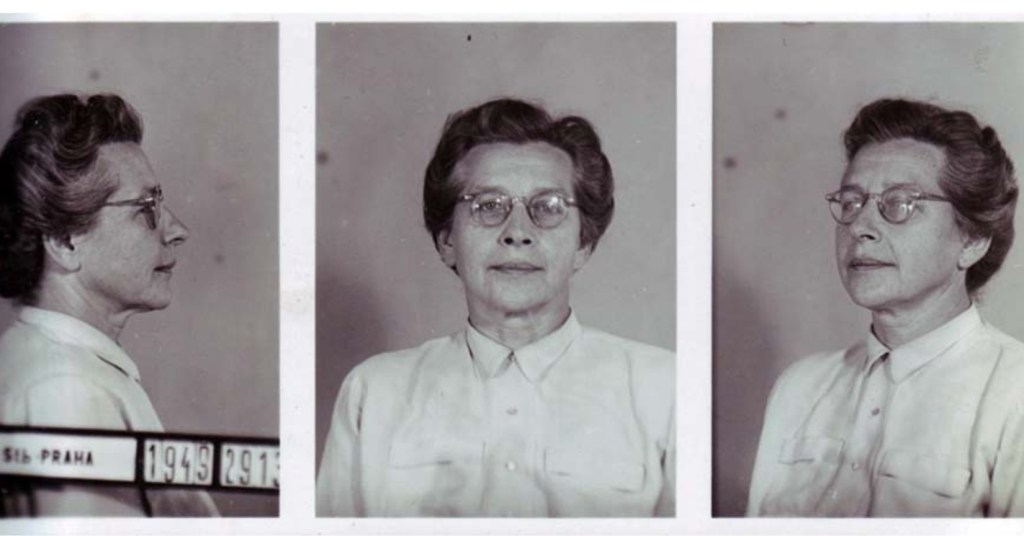
Even more appalling was the execution of Milada Horáková (1901-1950), a feminist who had been part of the anti-Nazi underground but then opposed the Stalinist takeover of Czechoslovakia. She was accused of treason and put on trial. Trained as a lawyer, she put up a spirited defence and was repeatedly shouted down by the judge.
Realising she could not escape a death sentence, Horáková (pictured below) proclaimed she was happy to be involved in a plot to overthrow the communists during her ten hours in the courtroom dock. The future leader of the British Labour Party, Michael Foot, a journalist at the time, wrote a blistering editorial for the left-wing Daily Herald. He noted how the women put on trial were treated with particular severity, suggesting a streak of misogyny among the comrades.
Foot fumed that socialists who had fought for workers’ rights since the early 20th century and been imprisoned and tortured by the Nazis were now being executed by Czechoslovakia’s communist rulers. They were no better than the Gestapo, he thundered. One report claimed that Horáková was hanged by slow strangulation taking between 13 minutes and just short of an hour to die. An absolutely monstrous crime against humanity.
As happened with Stalin’s purges in the 1930s, communists around Gottwald were liquidated. Rudolf Slánský (1901-1952) was the second most important communist after Gottwald but in 1951 was arrested, put on trial, and executed in 1952, along with several other leading party members. His downfall, orchestrated by Stalin, had anti-semitic overtones and he was exonerated in 1968.
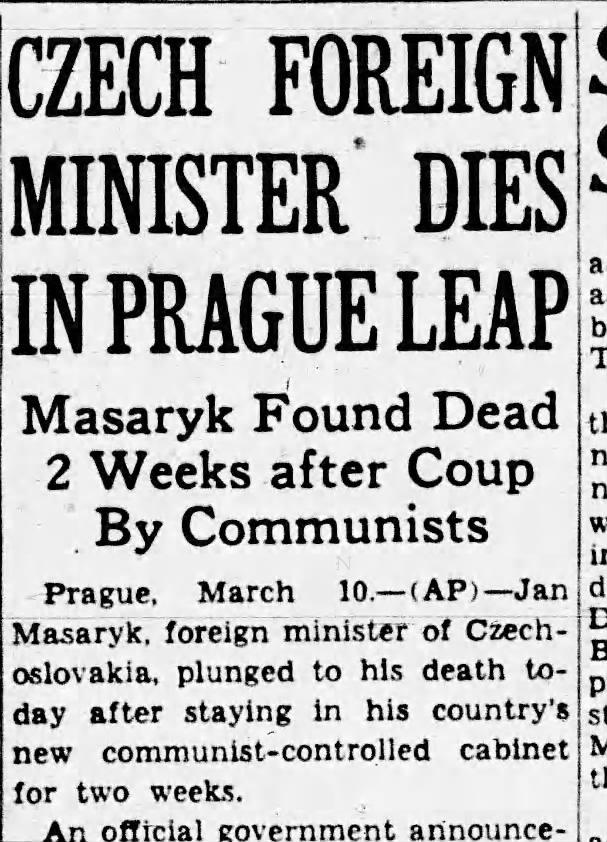
The most famous death during this period was the former Czech foreign minister Jan Masaryk (1886-1948) who fell out of a window in his pyjamas. Suicide? Murder? The jury is still out to this day. Prague had seen political defenestrations in the past with people thrown out of windows deliberately in 1419 and 1618. Was it a communist with a keen sense of history who sent Masaryk hurtling to the ground?
The Prague Spring of 1968
After the bloodletting of 1952, the communist regime bedded down to being one of the more stable eastern bloc countries. The party brushed aside Nikita Kruschev’s denunciation of Stalin in 1956 while Hungary was convulsed by a violent revolution that shook communism and resulted in Soviet military intervention.
When the 40th anniversary of the Russian revolution was celebrated in 1957, Prague was festooned with red banners and flags as well as neon red stars everywhere. Signs proclaimed Soviet peace and socialism. But as the 1960s dawned, it was clear that the rigidities of Stalinism were killing off economic growth.
The economic underpinning of the Prague Spring, that was about to explode across Czechoslovakia in 1968, were the reforms of a communist apparatchik, Ota Šik (1919-2004). During the Second World War, he had joined the resistance against the Nazis, been arrested by the Gestapo, and sent to Mauthausen concentration camp. There he met Antonín Novotný (1904-1975), president of the Czech republic between 1957 and 1968.
In the mid-1960s, Šik convinced Novotný to introduce some market reforms to try and kickstart the faltering economy. It would be tempting to compare Šik’s New Economic Model with Lenin’s New Economic Policy in the 1920s, only Šik was addressing a modern industrial power that had once been the industrial powerhouse of the Austro-Hungarian empire, accounting for about 70% of the empire’s output, but by the 1960s, it was the laggard of the eastern bloc.
Feeling that the party’s control over society was being steadily eroded, Novotný did a U-turn, reimposing censorship and repression. This led to him being publicly denounced by Alexander Dubček (1921-1992), pictured below, a Slovak communist politician, who urged both more economic liberalisation, as advocated by Šik, and greater openness.
Despite resorting to some dirty tricks to save his skin, Novotný was abandoned by the Soviet Union and Dubček took over as party leader and de facto ruler of Czechoslovakia. Dubček had spent a considerable part of his childhood and youth growing up in the Soviet Union. Despite his reforming instincts, the Kremlin viewed him as a loyalist.
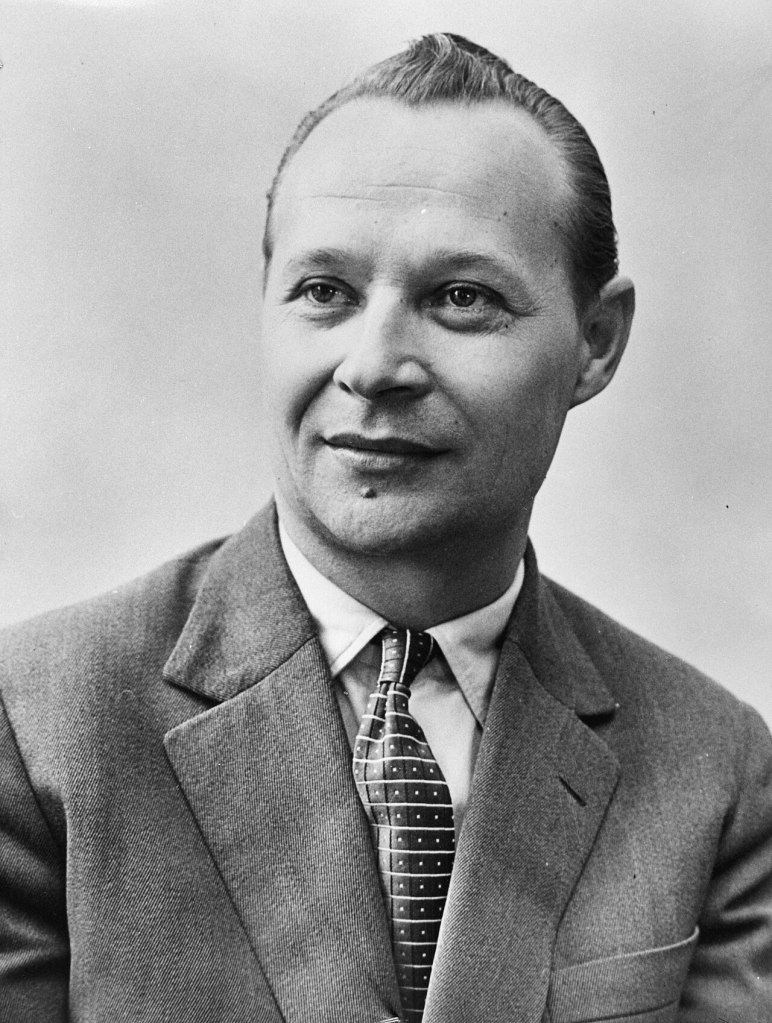
For his part, Dubček wasn’t seeking to destroy communism but to create what was termed “socialism with a human face”. He ended censorship and promoted freedom of speech. The power of the secret police was reduced. Šik’s decentralisation of the economy plus market reforms was accelerated. The idea was even floated of multi-party elections.
In Moscow, opinions of Dubček began to shift against him. Soviet leader Leonid Brezhnev (1906-1982) wanted stability in the communist world after the upheavals of the Kruschev era. Initially, the Kremlin adopted a wait-and-see approach to Dubček, who they hoped would both boost economic growth while keeping the Czech population calm and compliant.
But as 1968 went on, Brezhnev bristled at what Dubček was doing. In July, at a meeting in Čierna nad Tisou, the Soviets accused the Czechs of counter-revolution. On 3 August, eastern bloc leaders met and signed the Bratislava Declaration committing to Marxism-Leninism, international proletarianism, and a rejection of bourgeois and anti-socialist forces. Dubček signed, along with Brezhnev, but maybe the Czech leader’s fingers were crossed behind his back.
Adding to Soviet anxiety was the wave of rebellion sweeping across Europe and the United States in 1968. Far from welcoming the anti-capitalist demonstrations in France, Germany, and Britain, they vexed that traditional communist parties were being shoved aside by students, ultra-lefts, and – horror of horrors – Trotskyists. Worse, could this mood of exuberant rejection of the status quo in the west infect workers and students in the communist world?
Just three weeks after the Bratislava Declaration, the Soviet Union, Bulgaria, Poland, and East Germany invaded Czechoslovakia. Estimates range between quarter and half a million troops crossed the border in 2,000 tanks to crush the Prague Spring. Brezhnev termed this hostile act “fraternal assistance”.
Operation Danube, as the invasion was codenamed, assumed that Czech communists would rapidly fall into line. But many rallied to Dubček, who remained in power until April 1969. However, inevitably, the party began to bend to Kremlin pressure, especially as some officials were carried off to Moscow, in handcuffs, for re-education.
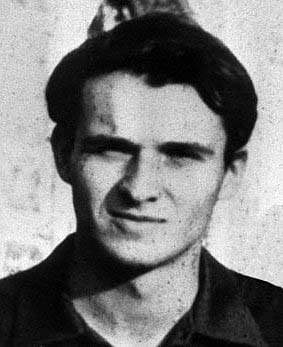
Growing despair had terrible consequences. One Czech student, Ján Palach (pictured below), burned himself to death. This provoked a massive demonstration and comparisons to the bravery of the 15th century Czech religious reformer Jan Hus, burned to death by the inquisition.
Gustáv Husák, a hardline Stalinist, replaced Dubček and Brezhnev asserted the Kremlin’s right to intervene in any socialist bloc country imagining it could break free from Stalinism. While the death toll from the invasion – about 137 people – was low compared to the bloodbath of the 1956 invasion of Hungary, it nevertheless cast a pall over the Warsaw Pact countries.
Dubček was disgraced but survived. Luckily for him, he did not share the fate of Hungary’s leader in 1956, Imre Nagy, who ended up dangling from the hangman’s noose.
Reaction to the Soviet led invasion
Reaction in the west to the Soviet invasion was mainly disgust – but not everybody drew the same conclusions. The letters page of The Guardian, a liberal leaning newspaper, on 24 August 1968 reflected typical views on the left.
For example, the secretary of the Vietnam Solidarity campaign wished to emphasise that the Prague Spring’s objectives had not been capitalist restoration but a better form of socialism (see below).
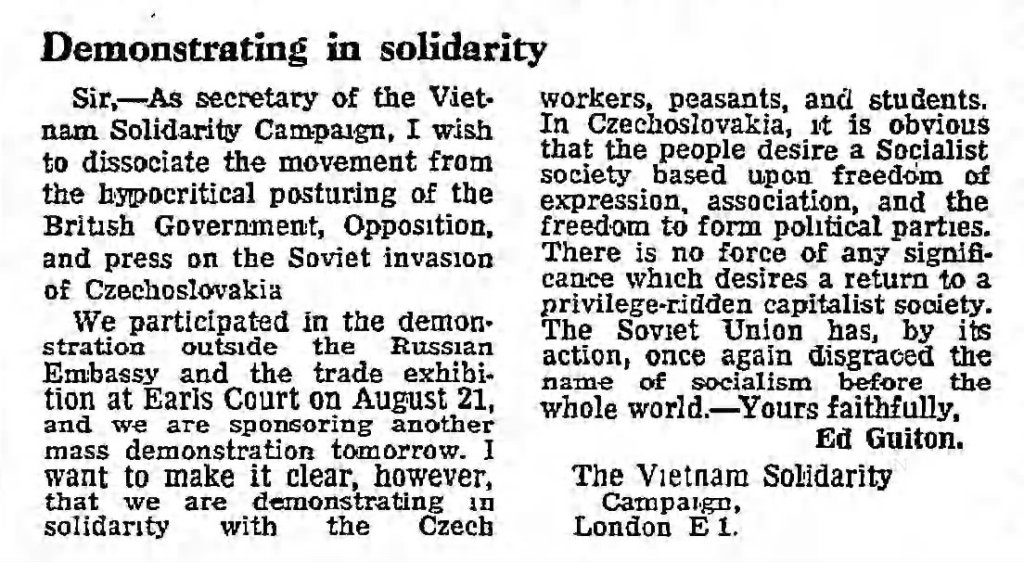
While another reader engaged in that favourite stance of many on the political Left, mistaken for deep thinking, termed ‘whataboutery’, where two unrelated events are compared so as to accuse the establishment of hypocrisy.
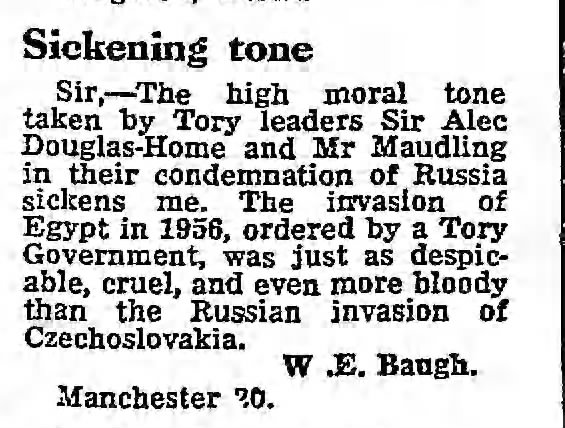
The events in Hungary in 1956 led to an exodus of members from communist parties in the west. Trotskyists said: we told you so. Defenders of Stalinism were mocked as “tankies”.
When the Prague Spring was crushed in 1968, this served to re-confirm that Moscow represented a very unappealing, totalitarian version of both socialism and Marxism that could not be the future.
Categories: History
 Marxism Explained
Leave a comment