
If you think the far Right is tough on migrants today, it’s worth looking back at how British communists talked about Polish exiles at the end of the Second World War. The language was hostile and uncompromising. But why were left-wingers, who supposedly espoused international working class solidarity, sticking the boot into workers from Poland?
Immigration as a political issue has been weaponised by far-Right parties across Europe and MAGA Republicans in the United States. But in the 1940s, British communists spread fake news about Polish migrant workers, echoing what we hear today from populist politicians.
Post-war demand for labour in Britain’s mines
The Second World War was ending. Hitler had blown his brains out in his Berlin bunker. The Soviet Army had overwhelmed central and eastern Europe. The three great powers – Britain, United States, and the USSR (Union of Soviet Socialist Republics) – set about dividing the continent into spheres of influence. Poland, in its entirety, moved into the Soviet orbit.
Millions of people were displaced from their homes, either as refugees or soldiers in action. Some yearned to return to their homes. Others had no homes anymore. The large Polish presence in Britain gazed on in horror as their country was swallowed by the old enemy: Russia. With the British government stating that its industry was short of workers, many decided to make the United Kingdom their new home.
One obvious industry in which to gain work was mining. In the 1940s, it still employed about 700,000 people. Dirty coal powered the nation’s factories and homes. England, Wales, and Scotland was dotted with mines but not enough miners to go below ground and hack out the precious black gold. That created an opportunity for those working the mines to demand better pay and conditions.
Communists active in the leadership of the National Union of Mineworkers (NUM) were not going to miss the chance to make their members the best paid workers in the land. Which was one reason they didn’t warm to those thousands of Poles who were up for getting their hands dirty. A foreign influx could undermine the bargaining position of the union.
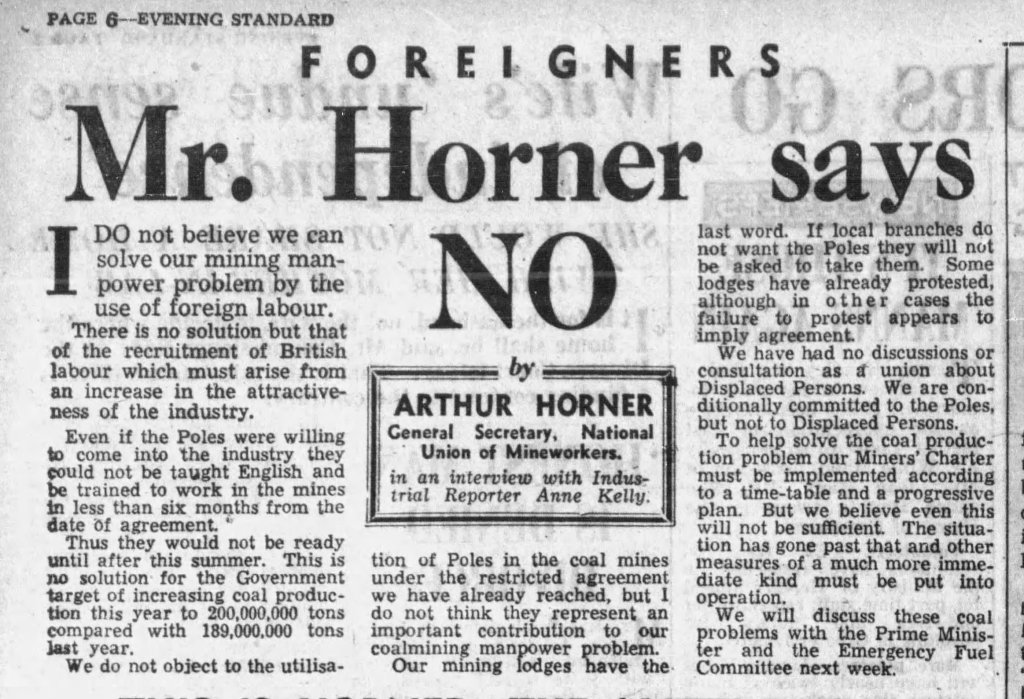
NUM leader Arthur Horner (1894-1968) didn’t want the coalfields flooded with Polish labour even though the Labour government of Prime Minister, Clement Attlee (1883-1967) saw it as an obvious solution to the post-war labour shortage.
Communists accuse Poles of fascism
But the problem wasn’t just a numbers game for Horner and other British communists. They were still loyal to Moscow. For them, the 1917 Russian revolution was the greatest event in history and the extension of socialism, even in its Stalinist form, to countries like Poland was something to be welcomed. If Poles didn’t want to return home to build the new society, with its rejection of capitalism, then something sinister was going on.
At the end of World War Two, there were about 200,000 Poles in Britain. They were a mix of demobilised soldiers and refugees. Many had fought in the Polish Armed Forces alongside Britain but tens of thousands more were deserters who had fled conscription into the Wehrmacht, the Third Reich’s armed forces. Others had been driven by the Nazis into forced, slave labour and escaped.
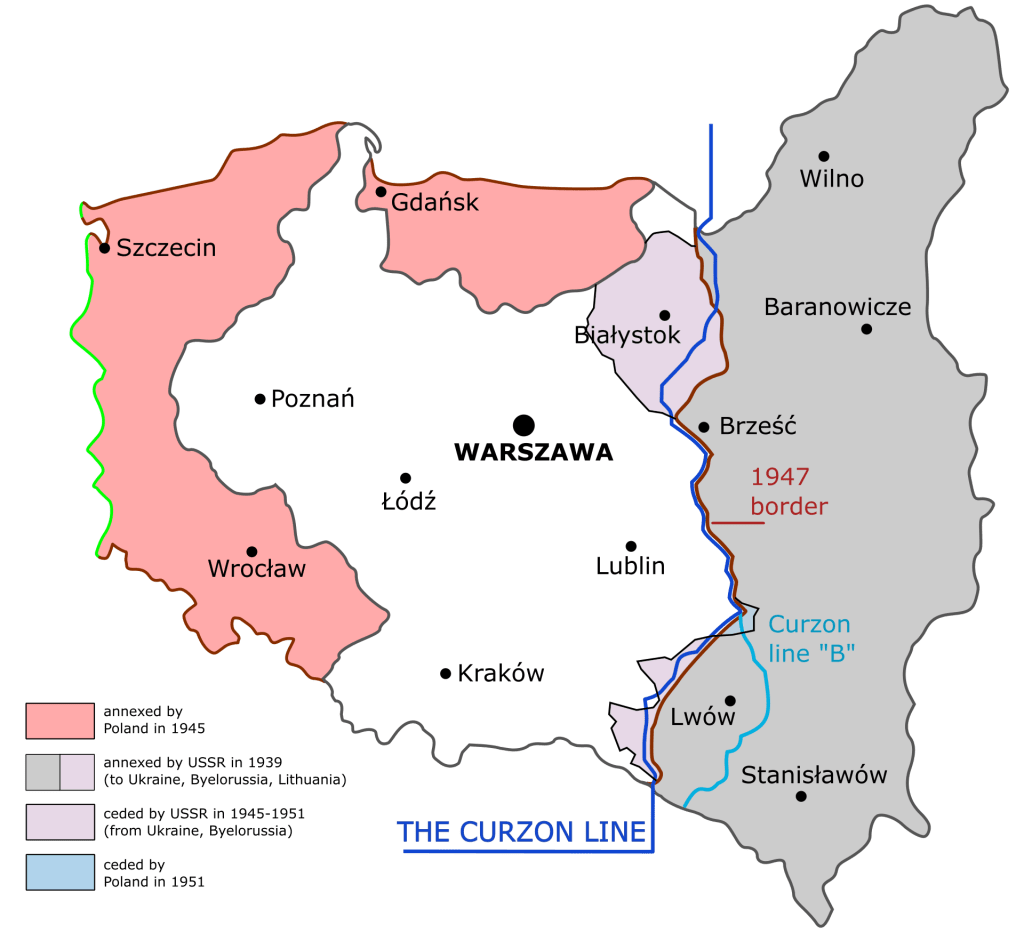
Many of these Poles didn’t wish to return to Poland as it was now in the Kremlin’s orbit. The Soviet leader, Joseph Stalin, had also shoved the entire country westwards by several hundred miles allowing the USSR to absorb eastern Poland, expelling millions of Poles in the process. Though, as a consolation prize, Poland got to annex some bits of Germany in 1945.
In 1946, the Attlee government set up the Polish Resettlement Corps (Polski Korpus Przysposobienia i Rozmieszczenia) to integrate soldiers from Poland now living in Britain into civilian life. These soldiers, living in military camps with their families, were retrained to become miners, construction workers, and agricultural labourers. This was followed by the Polish Resettlement Act in 1947, providing education and welfare services to Poles.
While the trade union movement recognised the labour shortage issue, especially as thousands of German prisoners-of-war who had worked the land were sent back home, they were unhappy at Poles being “dumped” on their industries. Even though jobs were not being filled, the memory of 1930s mass unemployment was still very raw, but also there was a large degree of xenophobia.
The usual stories, often unsubstantiated, of migrant bad behaviour began to circulate. Poles were Jew baiters, for example – even if this was a gross generalisation, not least because many Poles were Jews or had Jewish family connections. Nevertheless, one official of the TGWU trade union claimed that Poles “strut about like the arrogant fascists they are…wearing their Hitler decorations like they owed the place”.
The same official related an outbreak of violence where an entire Scottish town took on a group of menacing Poles. It was “our lads” versus bayonet-wielding foreigners. This account, presented to the Trades Union Congress (TUC) was disputed by the government. In fact, four or five British soldiers had turned up at a dance with broken bottles intent on beating up some Poles. That turned out to be the reality.
This prejudice against Poles was legitimised in crude terms by characterising them as fascists and ex-Nazi soldiers. In the mining industry, the union insisted on the screening of Polish entrants for alleged fascist sympathies. If they had fought for the Wehrmacht, they must have been indoctrinated into Hitler’s ideology, the argument ran.
This view got increased traction from the fact that Poland was becoming a communist state. Around 1947, the process of turning Poland into a one party communist state was well underway. By 1948, Polish communists merged with the Polish socialists to form the Polish United Workers Party that would rule the country as a one-party, totalitarian state until 1989.
The horror of the 1956 Hungarian revolt against communism and the Prague Spring of 1968, as well as revelations of widespread torture by the Stasi in East Germany, all lay in the future. Communists in the west pushed a far rosier picture of Soviet-controlled countries where private property was being abolished in the name of the proletariat.
In these early years of communism in central and eastern Europe, many trade unionists and left-wing activists in the west felt a kinship with the new regimes. They were workers’ states and to be supported. So, the refusal of Poles to go home and help build a socialist paradise could mean only one thing: they were counter-revolutionaries and fascists.
Polish musicians go home!
While the flashpoints of anti-Polish action in Britain were in the mining and construction industries, there was even simmering resentment among violin and trumpet players. In the 1940s, the Musicians Union was the subject of surveillance by MI5 over fears that communist activists were attempted to take over this trade union.
One of those under observation was assistant secretary Ted Anstey. In March 1948, he wrote a very irate letter to the Bucks Free Press complaining about a hotel in High Wycombe using a Polish parade band. The hotel manager claimed there were no available professional musicians in the town but Anstey disagreed. This incident, he fumed, was part of a sinister trend.
“If the nine Polish musicians concerned was an isolated instance of the infiltration of alien musicians, our organisation may have been able to absorb them.” While Anstey recognised that the band had been placed with the hotel under the terms of the Polish Resettlement Corps, he was going to make sure they were not used as musicians in future.
British Communists condemn use of Polish labour
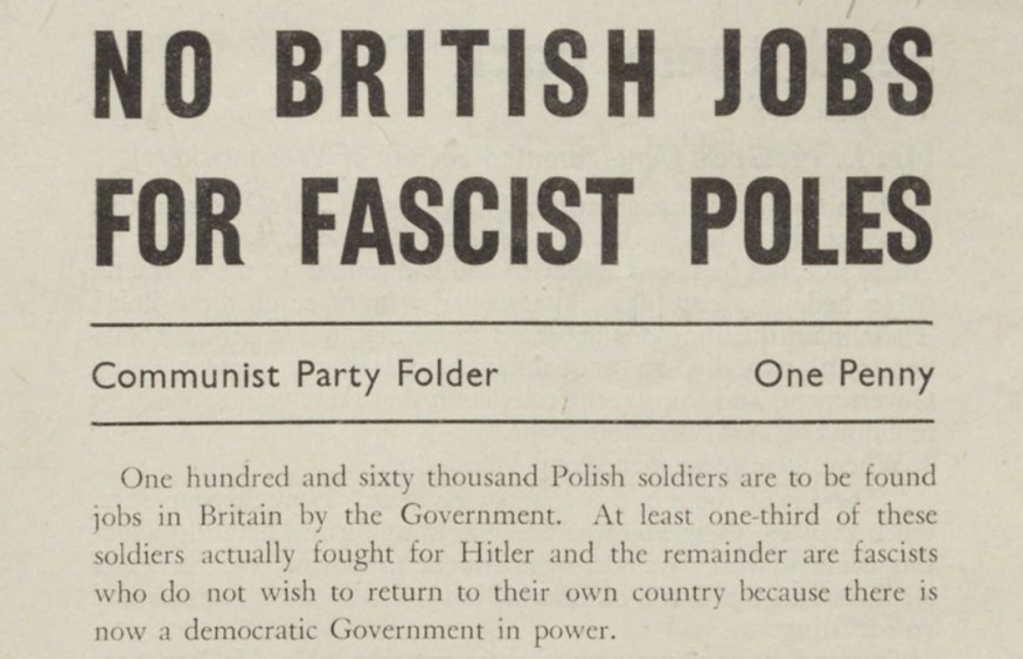
The Communist Party of Great Britain was very influential in the British trades unions and its position was uncompromising: “No British Jobs for Fascist Poles”. Their home country was now under communist rule and, ideally, they should go back, as the leaflet below makes clear.
The Daily Worker newspaper published articles by trade unionists claiming that Poles were taking housing that could be allocated to the “boys who fought in Burma, the heroes of Arnhem, and the Battle of Britain”.
Such an assertion was very emotionally charged. The end of the war saw the emergence of a mass squatting movement where thousands of working-class families, including ex-servicemen, took over military camps, luxury flats, and hotels. Suggesting that Polish people were forcing recently serving British soldiers on to the streets was only going to fuel anti-migrant anger.
Communists seemed unperturbed. This editorial below, by Horner, pulls no punches. He urges retired miners to put down their pipe and slippers and return to the pits. Anything but the Poles – was the nub of his message.
Ramping up the hatred
British communists kept up a mantra that the “democratically elected Polish government has repeatedly offered to take these men back”. How democratic was that election? Not very. Here were the results giving the communists and their allies an overwhelming victory.

But the CPGB banged on that Britain’s Poles were closet fascists and endangering relations between the UK government and the new socialist republic in Poland. Therefore, they should all go home.
As is the case with migrant bashing today, the CPGB spread tales of sexual misconduct by Poles. Nothing was guaranteed to rile nativist opinion more than lurid stories of Polish men slavering over young British girls. On 16 December 1946, the Daily Worker accused demobilised Poles at an army camp in Yorkshire of chatting up local girls aged between 14 and 18.
By late 1947, The Guardian newspaper reported that “political hostility to the Poles in Britain is endemic on the extreme Left of the trade unions”. It has been argued by some academics that the CPGB, and trades unionists opposing Polish employment, were not being racist, but merely defending workers’ rights. After all, as late as 2007, the Labour Party in Britain deployed the slogan: British Jobs for British Workers.
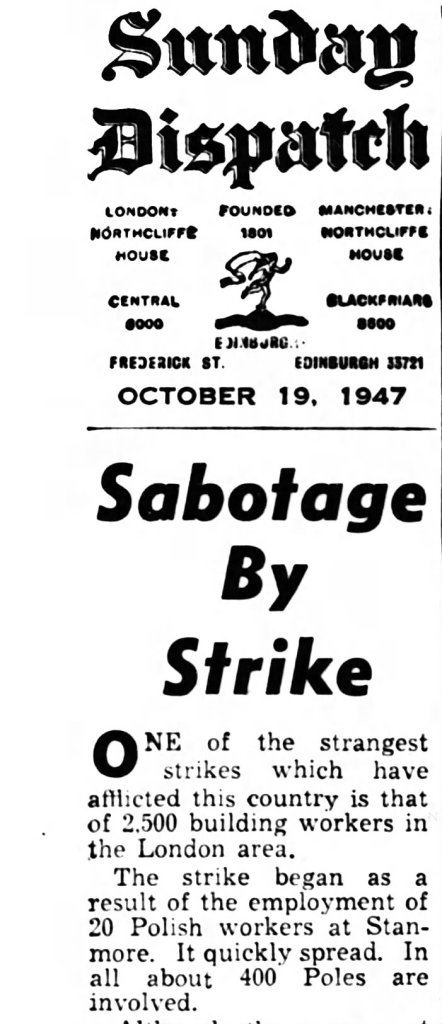
However, the CPGB’s stance legitimised hostility, even violence, against Polish workers and provoked strikes against employing them. In response, Tory leaning newspapers lambasted the communists as bigots who were undermining Britain’s economy recovery by preventing Poles from being employed in industry.
So, a reversal of today’s political split on the issue. In 1947, the communist left was migrant bashing while the Tory right was open to sucking in immigrant labour.
Some British workers were accepting
Despite the aim of British communists to see Polish workers compelled to return to the new Soviet-backed regime in their homeland, miners in Britain often had a favourable attitude to these immigrants, as one survey revealed.
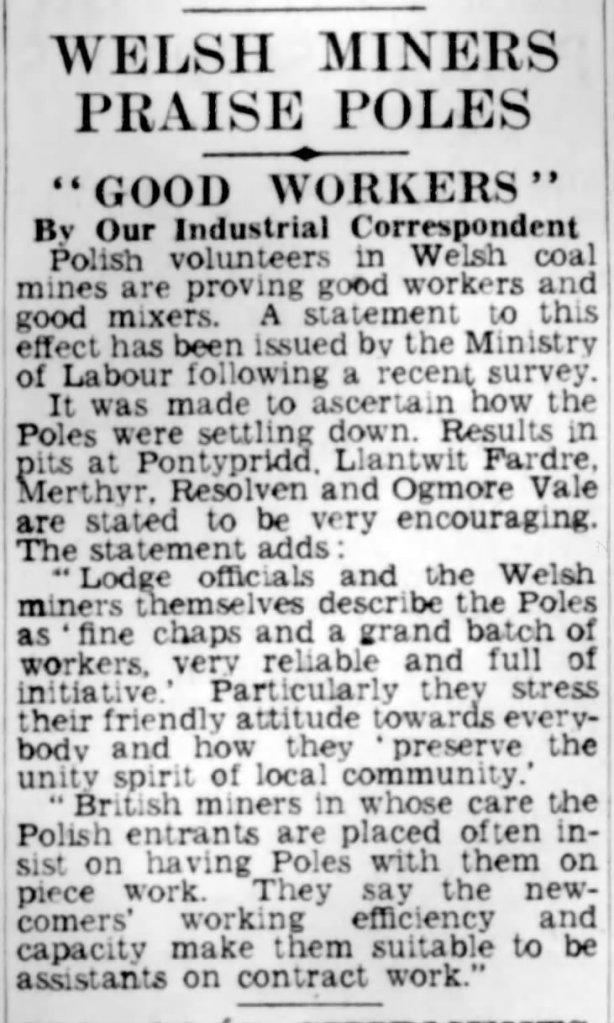
As for Polish workers, they were not silent. Some wrote letters to the newspaper explaining that they had issues with the Polish Resettlement Corps, which was not allocating them proper work; they were aware of the hostility of some to their presence in Britain; and going back to Soviet/communist run Poland was not an option.
One nameless Polish sergeant major wrote to The Guardian on 14 March 1947 complaining about being screened as a suspected “fascist” and being offered “odd jobs”. He apologised, sarcastically, for his “war-made ‘utility’ English” and suggested a solution to the problem:
“We want to emigrate to any tranquil spot on the globe (if there is any) where we will be received without prejudices (sic).”
Categories: History
 Marxism Explained
Leave a comment