
What lay behind the Soviet dictator Joseph Stalin’s increasingly hostile attitude towards Jews? Was he always anti-semitic or did his anti-Jewish policies result from increasing paranoia? Let’s investigate why the head of the USSR victimised and murdered Jewish communists and intellectuals with growing intensity in the years leading up to his death.
Joseph Stalin (1878–1953) – born Iosif Dzhugashvili – was a provincial Georgian who joined the Bolsheviks in 1903, working his way up the party and becoming general secretary in 1922. He lacked the intellectual brilliance of rivals like Leon Trotsky (1879-1940). His resentment at their political flare was increasingly compounded by their Jewish heritage.
Trotsky viewed Stalin as a bureaucratic mediocrity from early on, but it’s fair to say he never imagined how monstrous his opponent would become – even being prepared to use anti-semitic tropes to protect his power. That all lay in the future when the two men were plotting revolution against the Russian Empire in the run up to the 1917 revolution.
But as will be evidenced, once Stalin had removed the safety catch on his deep-seated anti-semitic prejudices, there was no going back. Indeed, the bile reached a crescendo in the months leading up to his death in 1953. Only then, did the Soviet Union dial back on his anti-semitic propaganda.
From tsarist pogroms to the hope of freedom
The late 19th and early 20th century in the Russian Empire was a wretched time to be Jewish. As imperial rule wobbled, under pressure from growing rebellious movements, Tsar Alexander III and Nicholas II – the last two tsars – unleashed bloody terror against Russian Jews.
Pogroms (organised massacres) typically involved a group of drunk soldiers and peasants, arming themselves, and on some flimsy pretext, marching down to the local Jewish ghetto intent on inflicting violence, rape, and death. They knew there would be no legal consequences – the authorities would turn a blind eye.
However, things didn’t always go their way. Across Russia and eastern Europe, Jews began to get organised and radicalised. This tide of murderous anti-semitism had to be halted. During one pogrom in Poland, the attackers met with a stiff response. A contemporary newspaper article in September 1906 described what happened:
“For the first time in the history of the pogroms which have disgraced Russia, the Jews offered something like organised resistance. Led by Jewish revolutionists the Hebrews entrenched themselves in houses and fired from the windows upon the besiegers. Fully fifty soldiers were killed or wounded.”
More typical though is what happened in Odessa in the same month. The day before the pogrom, a police officer – accompanied by soldiers – went round the city making “incisions” into trees located in front of Jewish shops to help the rioters find their targets. One police officer who had murdered two Jewish families the year before was taken to court, found guilty, and received a mere three years imprisonment for the slaughter of eleven people.
This headline below is from a syndicated newspaper report of a pogrom in Kiev. Bigoted locals had been plied with alcohol then unleashed on a Jewish ghetto with horrific consequences.
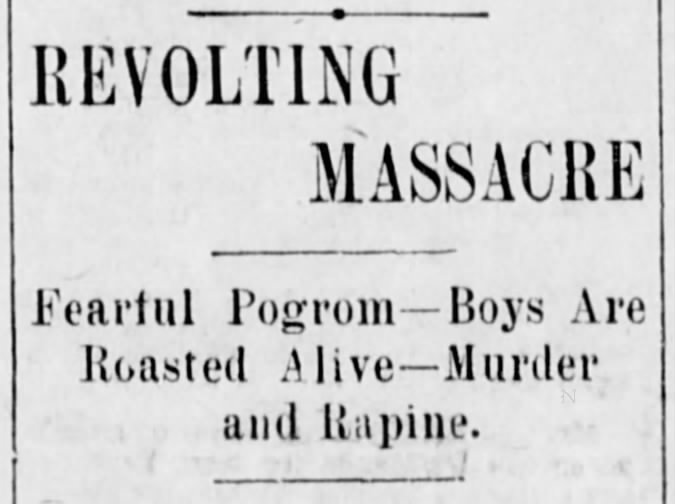
The organisers of this terror were the dreaded Black Hundreds. These paramilitary bands formed an unofficial arm of the tsarist state including groups like the Union of the Russian People and the League of the Archangel Michael. The carnage against Jewish people resulted in two million Jews leaving Russia for a new life in the west.
However, others stayed, joining groups dedicated to overthrowing the hated tsarist system.
The 1917 Russian revolution
In 1917, there were two revolutions in Russia. The February revolution ended the 300-year rule of the imperial Romanov dynasty bringing a provisional government to power ahead of planned elections for a constituent assembly.
It was forced to share power with the communist-dominated Petrograd Soviet – a workers committee initially controlled by the Menshevik communist faction but gradually taken over by the more revolutionary Bolshevik communists. The soviet wasn’t originally intended to be a governing body until the Bolsheviks raised the slogan: All Power to the Soviets! Effectively two parallel states competed for the loyalty of the Russian people.
As the provisional government failed to extricate Russia from World War One, as well as not delivering on agrarian reform, the Bolsheviks grew stronger and in October 1917, seized overall power in Russia. The soviets now ran Russia.
The Bund versus Lenin
The Jewish population was forcibly concentrated into cramped urban areas, known as ghettos, but this facilitated a high level of political organisation and fevered debate about how to create a society where they could be safe. Not everybody drew the same conclusion.
Zionists argued that Jews could only enjoy a secure future, and protect their religious heritage, in a designated homeland – most likely in Palestine though other places were suggested. Marxists like Isaac Deutscher (1907-1967), writing long after the Russian revolution, thought this was a mistake:
“The world has compelled the Jew to embrace the nation-state and to make of it his pride and hope just at a time when there is little or no hope left in it. You cannot blame the Jews for this; you must blame the world.”
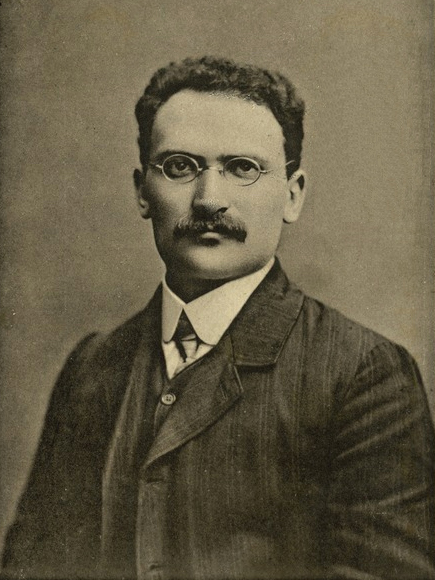
For Marxists, and others who favoured fighting for change in their birth countries, Zionism was a “bourgeois nationalist” that derailed the class struggle. But there were some Jewish thinkers, like Ber Borochov (1881-1917), pictured below, and Nachman Syrkin (1868-1924), who sought to reconcile Zionism and Marxism arguing that Jews could create the first thoroughgoing communist state.
The Bund was the most popular Jewish political grouping. In the midst of the pogroms, the Algemeyner Yidisher Arbeter Bund in Lite, Poyln, un Rusland (General Jewish Labour Bund in Lithuania, Poland, and Russia) was formed in 1897.
Better known as The Bund, it was socialist and anti-Zionist, arguing that Russian and Polish Jews had to fight for their rights in these countries, thereby rejecting emigration to a proposed homeland, such as Palestine. This was a policy of do’ikayt, which translates roughly as “here-ness”.
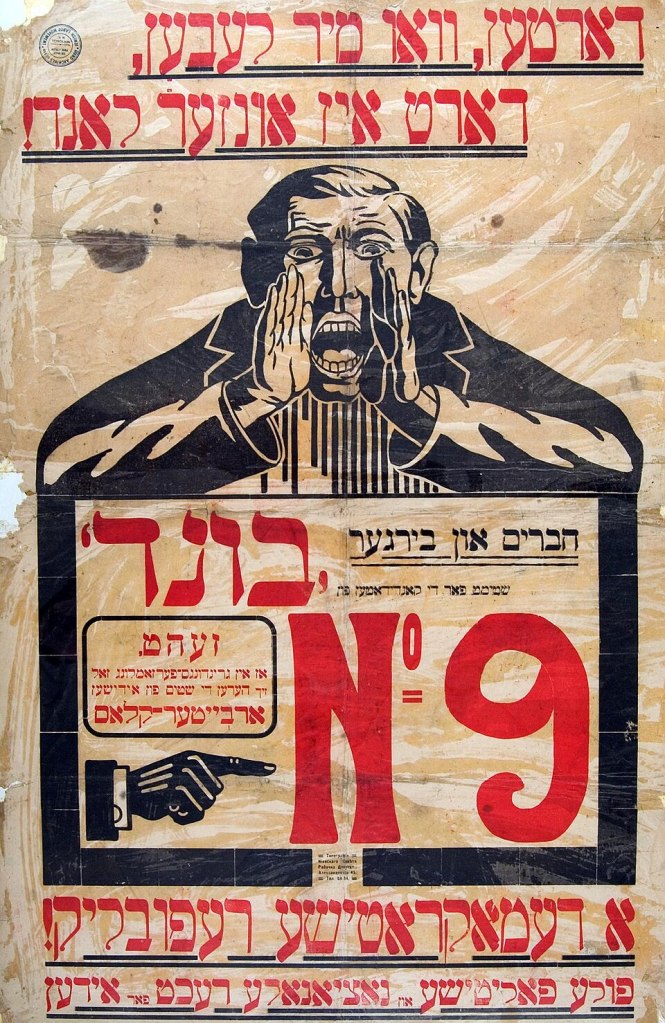
However, at the same time, The Bund (one of its election posters pictured below) viewed itself as the sole legitimate representative of the Jewish working class. In 1903, The Bund argued within the Russian Social Democratic Labour Party (RSDLP) – Russia’s main socialist party – that as part of a federated structure, the RSDLP would agree to recognise The Bund as the only voice of Jewish workers.
1903 was a turning point for the RSDLP as it split between Mensheviks who believed Russia needed to go through a capitalist phase of development before moving on to full-blooded socialism and Bolsheviks, led by Lenin, who were convinced this phase could be leapfrogged. As Lenin pushed for a full-blown communist revolution, he needed a highly centralised party capable of the task.
The Bund’s plea for autonomy within the communist movement wasn’t to his liking at all. Lenin wrote in 1903 that there was precious little difference between Zionists, arguing that Jews were a “nationality”, and the Bundist position:
“The idea of a Jewish nationality runs counter to the interests of the Jewish proletariat, for it fosters among them, directly or indirectly, a spirit hostile to assimilation, the spirit of the ‘ghetto’.”
Lenin then accused the Bundists of stirring up distrust between Jewish and non-Jewish workers to protect their political position. Worse, they claimed to oppose Zionism but were adopting the same arguments, even labelling the Bolsheviks as anti-semites.
“Only if it frankly and resolutely admits its mistake and sets out to move towards fusion can the Bund turn away from the false path it has taken. And we are convinced that the finest adherents of Social-Democratic ideas among the Jewish proletariat will sooner or later compel the Bund to turn from the path of isolation to that of fusion.”
The Bundists rewarded Lenin by supporting the Mensheviks after the 1903 split. With the benefit of hindsight, Lenin’s position looks heavy handed and insensitive given that Russian and eastern European Jews were still in the throes of the pogroms at this time.
From his revolutionary perspective, it may have seemed coldly logical, but it created a legacy of resentment and an opening for those within the communist movement who were – even if furtively – anti-semitic. This included Stalin who would later use anti-semitic tropes to vilify his main opponent, Leon Trotsky (1879-1940), and many others – as will be seen.
Russia’s Zionists were a divided bunch. Left-wing Zionists in the Poale Zion (Workers of Zion) demanded a Jewish socialist state in Palestine. Other Zionists yearned for a state in Palestine, but were less concerned if it was socialist or not.
Another left-wing Jewish group was the Fareynikte (The United Jewish Socialist Workers Party), strongest in Ukraine and unlike the Bund, supportive of autonomous Jewish areas. The Bolsheviks rejected an offer to merge with them in 1919, accusing the Fareynikte of separatism.
Bolsheviks and Jews after the revolution
As the Bolsheviks consolidated their power after the October 1917 revolution, they set up the Yevsektsiya (short for Evreyskaya sektsiya, which translates as the Jewish Section) in 1918. It published a Yiddish-language newspaper, Der Emes (“The Truth”), that ran alongside the main Bolshevik organ, Pravda – also meaning truth.
Many Jews were attracted to Bolshevism and were well represented at a senior level. Leon Trotsky (born Lev Davidovich Bronstein), Lev Kamenev, Grigory Zinoviev, Yakov Sverdlov, Maxim Litvinov, and many others were from Jewish backgrounds. But they were at pains to prioritise the global class struggle over Jewish communal identity.
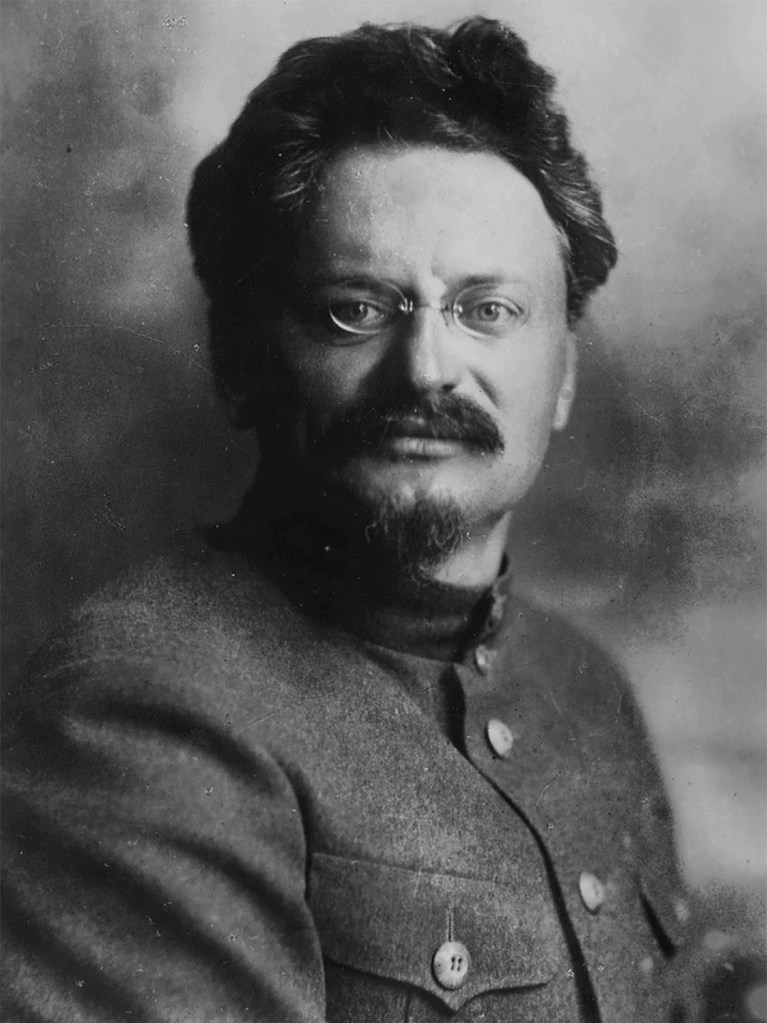
As People’s Commissar for Military and Naval Affairs between 1918 and 1924, Trotsky (pictured below) led the Red Army, seeing off military opposition to the new Bolshevik state. In these years, he regarded himself as a Marxist, being very dismissive of his Jewish roots.
However, once his judaism was weaponised by Stalin in his struggle against him, plus the unfolding horror of the Nazi holocaust in the 1930s, Trotsky’s position modified. He certainly never became a Zionist but his later writings, especially after the trial and execution of his son in Stalin’s purges, reveal a greater understanding, and horror, at how anti-semitism had not only persisted, but was exploited by the Soviet state in the decades after the 1917 revolution.
So, what was the appeal of Bolshevism to some Jewish political activists?
The overwhelming persecution under the Tsarist empire forced Jews to consider their political position and agitate for fundamental change. While a majority embraced either Bundism or Zionism, a significant number joined the Bolsheviks. Lenin’s party offered proletarian internationalism, the rejection of religious tradition, and the expropriation of landlords and capitalists.
The fact that Jews joined the Bolsheviks appalled some in the diaspora. In March 1926, the secretary of the Board of Deputies of the British Jews wrote to the Ealing and Acton Gazette:
“This board does not maintain that there are no Jewish Bolsheviks, but it endeavours to make the public understand that, with the exception of a small handful of misguided men who have abandoned all their religious teachings, the vast mass of the Jews in Russia and all other countries are unhesitatingly anti-Bolshevik.”
Many Jewish organisations played down the role of Jewish Bolsheviks, in part because of fears that extreme-right anti-semites were fostering the myth of Jews having organised the 1917 Russian revolution.
This was a new spin on an old myth going back to the 18th century where Jews, Freemasons, Illuminati, Rosicrucians and still-existing Knights Templar were accused by writers like the Jesuit propagandist Augustin Barruel (1741-1820) of provoking the 1789 French Revolution.
Now, the myth was further sustained by the publication in 1903 of a hoax, The Protocols of the Elders of Zion, which purported to be the minutes of a secret meeting of Jewish leaders plotting to take over the world. In fact, it was a forgery by the Tsarist secret police, the Okhrana. Sadly, it’s still believed in some circles today – notably among neo-fascists, and in the Middle East.
So, the presence of many people of Jewish heritage in the Bolshevik leadership was seen as problematic by non-communist Jews. Ironically, once Stalin drifted more explicitly towards anti-semitism, he began purging the Soviet state of those from Jewish backgrounds. By the time of his death in 1953, Lazar Kaganovich (1893-1991) was the only old Bolshevik from a Jewish background who was close to Stalin and still alive.
Stalin’s heavy handedness
In 1907, Bolsheviks and Mensheviks attempted a brief but unsuccessful reconciliation at a congress in Stockholm, Sweden. This was ten years before the Bolsheviks took power in Russia. Stalin penned a report for the Bakinsky rabochy (Baku Worker) newspaper on the debates, noting the predominance of Jews in the Menshevik faction.
He seemed to take pride in the more “Russian” profile of the Bolsheviks and then made a reference to pogroms, foreshadowing his own future penchant for purges as well as his latent anti-semitism.
“…the overwhelming majority of the Bolshevik faction consists of Russians, after which come Jews…For this reason one of the Bolsheviks observed in jest (it seems Comrade Aleksinsky) that the Mensheviks are a Jewish faction and the Bolsheviks a genuine Russian faction, so it would not be a bad idea for us Bolsheviks to arrange a small pogrom in the party.”
After the October 1917 revolution, the Bolsheviks were at pains to stamp out the anti-semitism of the imperial era. The Council of People’s Commissars urged party members in factories and workplaces to be vigilant against anti-Jewish sentiment and Trotsky made attacks by Red Army soldiers against Jews a crime punishable by the death penalty.
However, in 1918, a wave of pogroms broke out in Moscow, Petrograd and the so-called Pale of Settlement – this was the geographical area into which Jews had been herded by the imperial authorities from the 18th century onwards. Trotsky had to confront the fact that Red Army troops were involved in these atrocities.
The right of “nations” to self determination
After the revolution, Stalin was appointed People’s Commissar for Nationalities. By birth, he was a Georgian whose original name was Ioseb Besarionis dze Jughashvili, but he was always keen to show that his loyalty was not to Georgia but communist internationalism.
Lenin trod carefully on the issue of self determination for nations, though he baulked at the Bund seeking to be the sole representative of Jews as a nation within Russia. Nevertheless, if the working class in an oppressed nation wanted independence, Lenin was prepared to support that without abandoning the hope that working class unity across borders could be achieved further down the road.
In 1917, Lenin proposed a voluntary union of socialist republics. Lenin’s instinct was to centralise but he realised the need for tactical flexibility. Russian imperialism under the tsars had, after all, left a bitter legacy. His approach contrasted with Stalin who viewed national minorities, demanding greater autonomy, as being in a state of disobedience to Soviet power.
In 1921-1922, as Lenin’s health declined, Stalin pressed ahead with a de facto invasion of Georgia to bring it firmly into the Soviet Union, despite the opposition of local Bolsheviks. This incident, dubbed the “Georgian Affair”, contributed to a final breach between Lenin and Stalin.
Stalin’s commissariat included the Jewish section, the Evreyskaya seksiya, which published the Bolshevik Jewish newspaper, Der Emes. The editor and founder of that newspaper was Semyon Dimanstein (1886-1938), a party loyalist who had cut his political teeth before the revolution clashing with Bundists and Zionists.
Lenin died in 1924 and Stalin lost interest in the commissariat, shutting down the Jewish section in 1929. During the purges of the 1930s, Dimanstein was arrested, interrogated, and executed in 1938. Two years after Stalin’s death in 1953, he was rehabilitated posthumously by the Soviet Union.
Stalin uses anti-semitic tropes against Trotsky
After Lenin’s death, Stalin grabbed the reins of Soviet power, out-manoeuvring Trotsky. By 1927, he had expelled Trotsky from the communist party; in 1928, Trotsky was sent to internal exile at Alma-Ata in modern Kazakhstan; and finally in 1929, he was thrown out of the Soviet Union.
The two had profound ideological differences. Trotsky advocated “permanent revolution” arguing that Russian society could not advance to fully-fledged communism if it remained with the borders of that country. Stalin edged towards a modus vivendi with the capitalist west where revolution was still publicly advocated but in reality, there was an emerging pragmatism.
This resulted in the solidification of a totalitarian bureaucracy, burying the notion that the “dictatorship of the proletariat” was an intermediate phase between capitalism and full-blown communism, where the state apparatus would wither away. Under Stalin, the state strengthened significantly. In domestic and foreign policy terms, the Soviet Union acted more like a traditional “great power” than an agent for global revolution.
In what would become a repeated theme under Stalin, the internationalism of Trotsky and his followers (once a rallying call for all Marxists) was now construed as evidence they were unpatriotic and plotting against the Soviet government. It didn’t take Stalin long to realise that the Jewish heritage of Trotsky and other purged Bolsheviks could be used to portray them as untrustworthy, alien foreigners.
As Stalin ramped up the party purges in the 1930s, Trotsky wrote that they were “staged with the hardly concealed design of presenting internationalists as faithless and lawless Jews who are capable of selling themselves to the Gestapo…”.
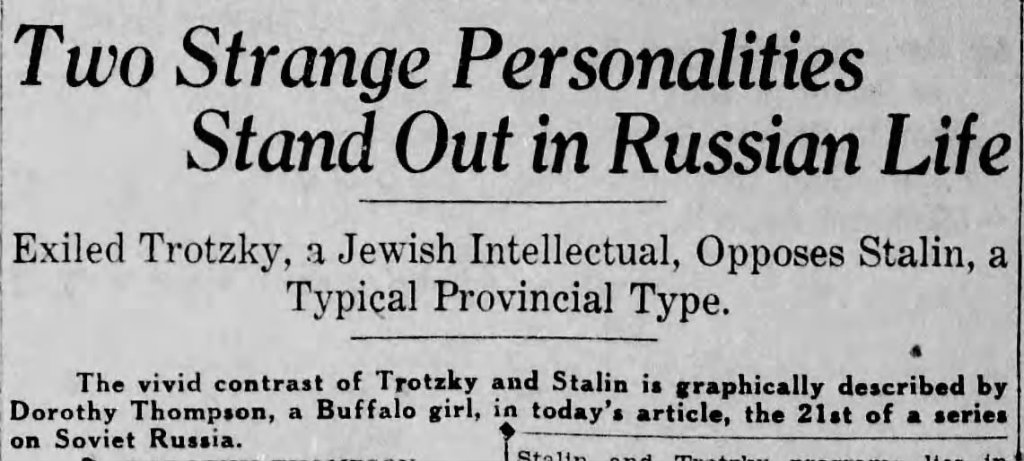
On 29 February 1928, The Buffalo News ran an article contrasting Stalin and Trotsky with the former described as a “provincial type” while Trotsky was a “Jewish intellectual” who ran rings around Stalin in political arguments.
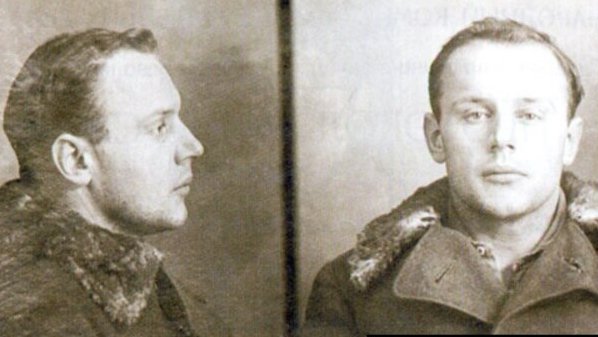
In 1935, Trotsky’s son – Sergei Sedov (pictured below) – was put on trial accused of trying to poison hundreds of Russian workers. This absurd allegation was rooted in the medieval “blood libel” slurs against Jews in the Middle Ages with lurid accounts of Christian children being sacrificed in Jewish rituals. Sedov was executed two years later and then pardoned by the Soviet authorities in 1988.
Stalin’s growing embrace of anti-semitism for cynical political purposes reached a new low in 1939 as he desperately sought a rapprochement with Nazi Germany. Terrified at Hitler’s growing military might – having executed many top Soviet officers as suspected Trotskyists – Stalin ordered a purge of Jews in the foreign ministry in the vain hope that would impress Hitler.
Stalin’s world view was not rooted in the same fascist and racist ideology of the Nazi party but, as Trotsky wrote bitterly in his last essays before being assassinated by a Stalinist agent, there was a convergence of interest between the two totalitarian dictatorships. A bi-product of this was a reversion to anti-semitic policies supposedly consigned to the dustbin of history in 1917.
Stalin proposes a Jewish homeland – in Siberia
In 1928, Stalin tried to head off the growing Zionist movement by proposing a Soviet homeland for Jews…in Siberia. It was to be located in the Biro-Bidzhan district within the Khabarovsk Krai of the Soviet Far East, bordering China.
The overwhelming majority of Soviet Jews lived in cities, working in urban jobs. This was a legacy of the imperial era where Jewish people were driven into ghettoes. Now, under Stalin’s plan, they were to be uprooted and dumped in a swampy wasteland.
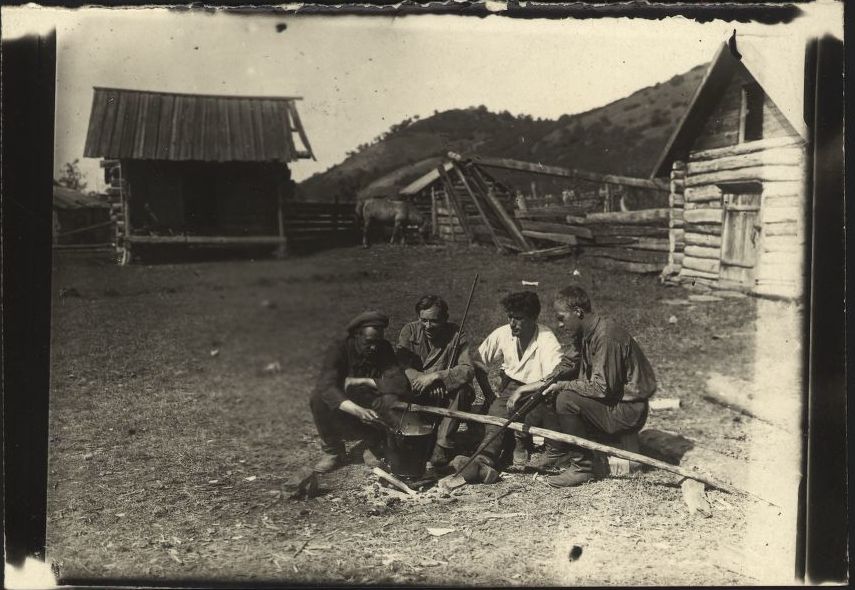
In 1934, this unpromising territory was designated a Jewish Autonomous Oblast (JAO). It barely lasted beyond the end of the decade as Jews sent there (pictured below) quietly made their way back to the cities. By this time, Stalin was too distracted by the series of purges he was inflicting on his own party to notice Jews in the oblast trekking home.
His attempt to undermine the Zionist proposition came to nothing. The rise of fascism in Europe; the horror of the Nazi holocaust; and the growing settlement by Jews of British-controlled Palestine led inexorably to the formation of the state of Israel after the Second World War.
This presented a new challenge for the Soviet Union and unleashed the most overt anti-semitism from Stalin, showing the degree to which he had degenerated along with the hellish society created under his rule. Meshed with his personal paranoia, a very dangerous situation developed for Russian Jews in the late 1940s and early 1950s.
“Rootless Cosmopolitans” campaign
In the late 1940s, the arts became a political battleground. Stalin fixated on theatre critics as a threat that the communist party must address. A report was commissioned into their “unpatriotic” reviews and the effect this was having on the Soviet public. It had not escaped Stalin’s attention that many of these critics were Jewish.
In March 1949, Radio Moscow broadcast the details of an investigation into these dangerous arts reviewers:
“The report exposed shocking facts of foul anti-people’s activity by the rootless cosmopolitans who mocked everything that is advanced, party-centred, and truly popular in the plays of Soviet dramatists. These passport-less loafers, the offspring of bourgeois aesthetes and formalism, abused the best leading writers.”
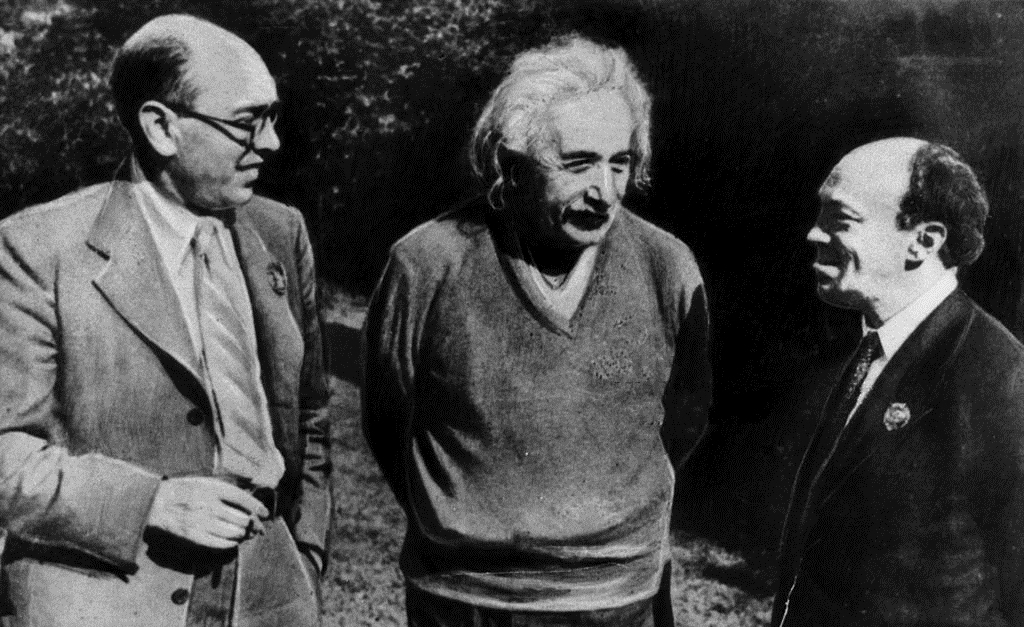
More seriously, in 1948, the director of the Moscow State Jewish Theatre, Solomon Mikhoels (1890-1948), pictured below with Albert Einstein, was murdered in Minsk. During the war he had chaired the Jewish Anti-Fascist Committee, a Soviet-backed initiative to raise western support, especially from Jewish communities, for Stalin’s war against Hitler.
The committee was set up by two Bund members, released from the gulag in 1941, who were then re-arrested months later. Mikhoels was regarded by the Kremlin as a safe pair of hands touring Europe and the United States to raise funds for the Soviet war effort and encourage Americans to join the fight against Hitler.
But his success provoked Stalin’s paranoia. Instead of applauding the committee’s sterling efforts, the Soviet leader planned its downfall. Mikhoels died in a staged car accident in 1948, while other committee members were arrested.
On what has become known as the Night of the Murdered Poets, 12 August 1952, those taken into custody were executed secretly in the basement of the Lubyanka prison. This included the Yiddish language poet Peretz Davidovich Markish (1895-1952), the writer Dovid Bergelson (1884-1952), the translator of The Internationale into Yiddish, Itzik Feffer (1900-1952), and an author of children’s books, Leib Kvitko (1890-1952).
Stalin blows hot and cold on Israel
Two political processes lay behind this bizarre campaign. First was Stalin’s drift from communist internationalism to chauvinist nationalism, reviving old prejudices on the way. Second was the growth of Zionism among Jewish communities – a legacy of the Nazi holocaust of millions of Jews and the creation of the state of Israel.
In May 1948, Israel declared its independence. The following day, the Arab League (mainly Egypt, Jordan, and Syria) invaded the area proposed for Palestinians and began attacking Jewish areas. Stalin supported the Israeli side, mainly in the hope of gaining a new socialist ally in the Middle East and weakening both American and British influence in the region.
The main Zionist paramilitary organisation, the Haganah, was supplied with weapons via communist Czechoslovakia. Ironically, these weapons had been largely manufactured by the Third Reich and then left lying around, surplus to requirements, when World War Two ended. Now Stalin passed this military hardware on to Israel.
However, true to his mercurial nature, Stalin was turning on Israel before the end of 1948. The first Israeli ambassador to the Soviet Union was the future prime minister, Golda Meir (1898-1978). On visiting the Moscow Choral Synagogue in October 1948, she was given a rapturous reception by thousands of Jewish Russians. This shook Stalin’s confidence that he could control Soviet Jewry.
More alarmingly, Israel was not following the path of the new communist states in eastern Europe, like Hungary and Poland. Instead, it was embracing parliamentary democracy and moving away from the socialist ideals of the kibbutz movement. Overtures to America were the last straw for Stalin. Overnight, he pivoted towards the Arab states offering up the Soviet Union as their protector.
The Doctors’ Plot
In the final tragic act of Stalin’s reign of terror, a group of up to 37 Moscow doctors – most of them Jewish – were accused of plotting to assassinate Soviet leaders. This included several of the country’s top military commanders, pictured below.
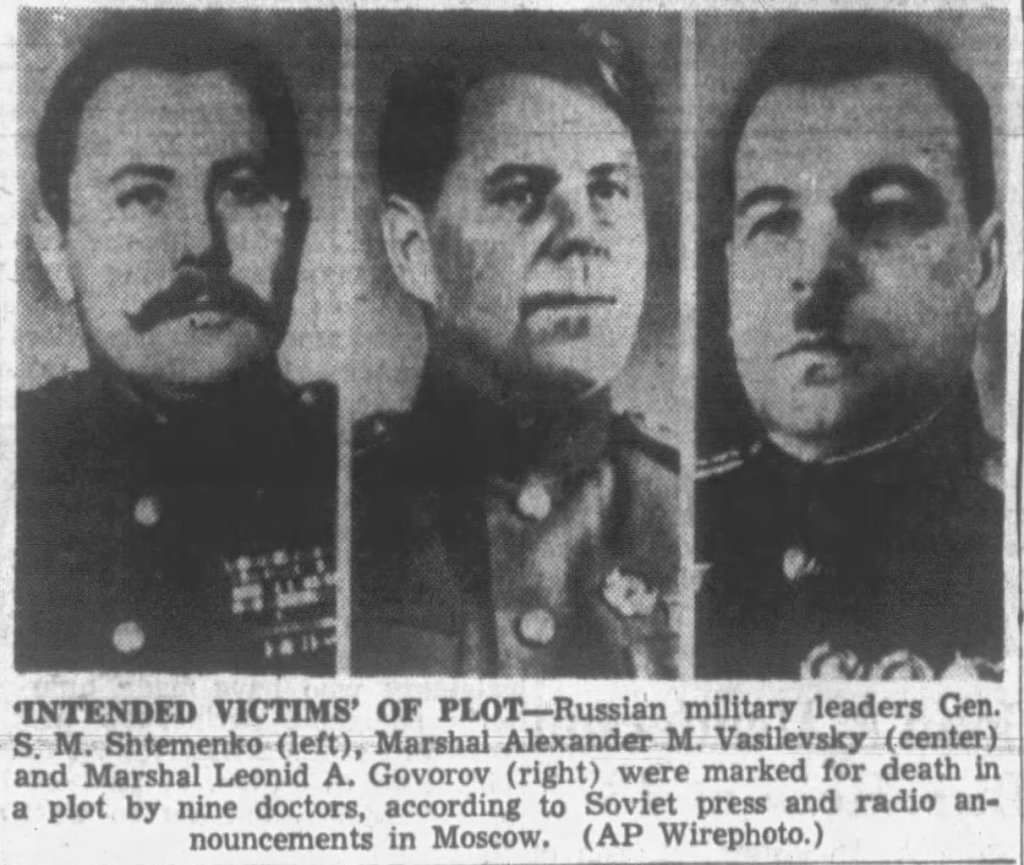
The allegations originated with a cardiologist, Lydia Timashuk (c.1898-1983), who claimed her medical superiors were involved in this murderous conspiracy. Some sources suggest that even Stalin didn’t swallow this at first but by January 1953, he was in full show trial mode.
That month, the newspaper of the Communist Youth League in the Soviet Union – Komsomolskaya Pravda – thundered that the Doctors’ Plot was proof that the purges of the 1930s still had unfinished business. These doctors, it claimed, were “pitiful bandits” comparable to the Mensheviks, Trotskyites, and Zinovievites.
But mainly they were capitalist fifth columnists:
“Capitalist encirclement strives to use for its repulsive purposes remnants of destroyed groups hostile to Soviet power, morally unstable, decayed people, who still remain among us.”
The Soviet news agency TASS gave more details, bringing the Jewish angle to the fore:
“The majority of the participants of the terrorist group – Vovsi, B. Kogan, Feldman, Grinstein, Etinger and others – were bought by American intelligence. They were recruited by a branch-office of American intelligence – the international Jewish bourgeois-nationalist organization called “Joint.” The filthy face of this Zionist spy organization, covering up their vicious actions under the mask of charity, is now completely revealed…”
The reference to ‘Joint’ by TASS was the American Jewish Joint Distribution Committee, founded in 1914 as a global charity backing community programmes and disaster relief. Stalin’s propagandists turned it into a spy organisation to which the Soviet doctors were linked.
What seems astonishing is that so soon after the holocaust of millions of Jews across Europe and Russia, Stalin embarked on a purge that specifically implicated Jews as plotters.
Consider that in the closing stages of World War Two, Red Army units, pictured below, had liberated several concentration camps and seen with their own eyes the evidence of Nazi barbarism. These camps included Auschwitz, Treblinka, Sobibor, and Sachsenhausen.
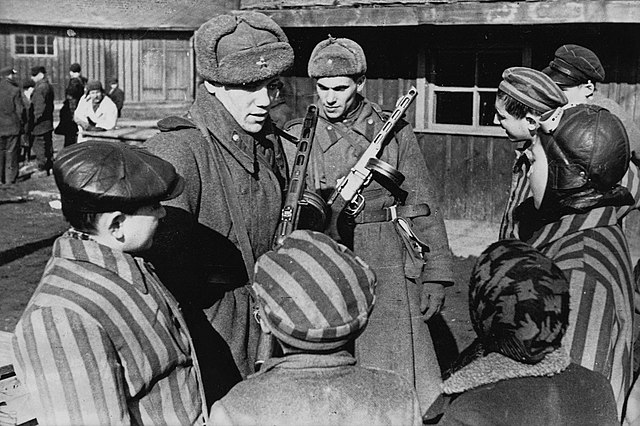
Hungarian communists frame Jewish leaders on murder charges
In the first quarter of 1953, the Doctors Plot sent a clear signal to the Soviet Union’s client states in eastern Europe to follow the party line. The newspaper of the Hungarian communist party, Szabad Nép (Free People), denounced Joint as “Zionists and bourgeois nationalist Jews” which required “more energetic steps” against these “hotbeds of hostile activity”.
Lajos Stöckler (1897-1960), president of the (Buda)Pest Israelite Congregation and the National Office of Hungarian Israelites, was arrested, on a trumped up murder charge. Alongside two other Hungarian Jewish leaders, Miksa Domonkos (1890-1954) and Dr. László Benedek, he was subjected to brutal torture by the State Protection Authority (ÁVH) to extract a confession.
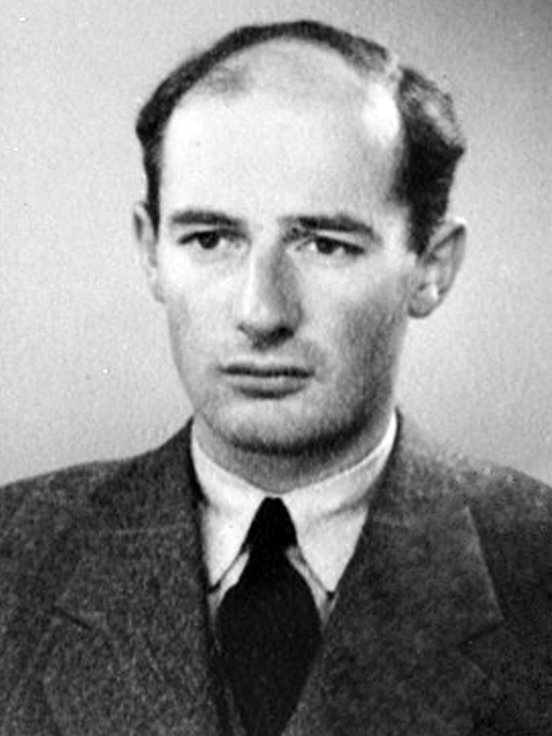
And who was the alleged murder victim? In a breathtaking example of Stalinist cynicism, the three prominent Hungarian Jews were being framed for the murder of Raoul Wallenberg (1912-c.1947), pictured below, a Swedish diplomat who rescued thousands of Jews during the period of Nazi occupation in Hungary.
Proving that no good deed goes unpunished, Wallenberg was arrested by the Red Army’s intelligence unit, SMERSH, after Budapest was liberated in 1945, accused of espionage for the Americans. He was spirited away to the Lubyanka prison where he either died of a heart condition or was executed. After Stalin’s death the Soviets admitted that he had died in Moscow.
However, in early 1953, there was an altogether different story. Stöckler was said to have shot Wallenberg in the basement of the American embassy, standing over the dead body with a smoking gun in his hand. Pause to consider the absurdity of this scenario. Stöckler, and his co-accused, had killed a man who smuggled thousands of Jews out of Nazi-controlled Hungary – according to their communist prosecutors.
Meanwhile, Romanian communist newspaper, Scînteia (The Spark), called for vigilance against “fascist dregs, Jewish and other bourgeois nationalists, and cosmopolitans without country or people”. Given this heightened anti-semitism, the Zionist Organisation of America (ZOA) asked the Soviet Union for permission to organise the mass migration of 2.5 million Jews from eastern Europe to Israel. The Kremlin responded that Jews did not need a “promised land”.
Within Israel, pro-communist Jewish groups came under increased scrutiny with this outbreak of overt anti-semitism in the USSR and eastern Europe. Mapam was an Israeli political movement rooted in the kibbutz, military, and urban working-class. Immediately after Israeli independence, it was the main left-wing party.
Mapam combined Marxism and Zionism with support for the Soviet Union. But the Doctors’ Plot provoked splits within Mapam, leading to its decline as a political force. Many Israeli intellectuals who had viewed the Soviet Union as a beacon for change and tolerance, now turned against Moscow. This was the legacy of Stalin’s paranoia.
It took the death of Stalin to end this madness with Soviet leaders immediately coming clean, exonerating the accused doctors, and blaming the dead communist dictator for what had begun to evolve into another massive purge. Sadly, Stalin’s death came too late for the Jewish intellectuals executed in 1952. But the doctors were more lucky as the newspaper headline below indicates.
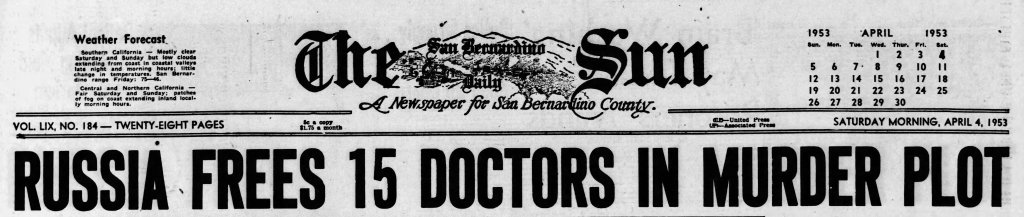
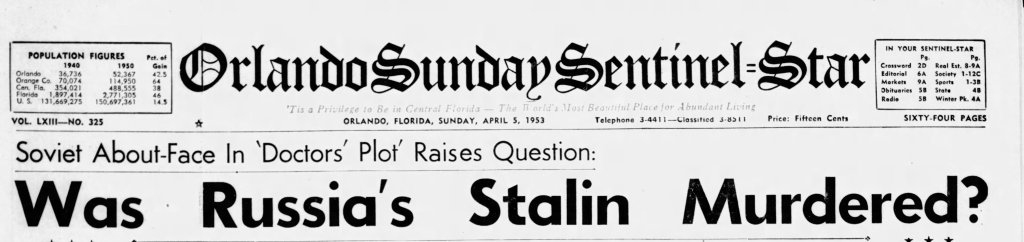
All of which raised a more pertinent question – did the prospect of another full-blown 1930s style purge lead to Stalin being bumped off. Some western media thought so.
Trotsky tries to explain Stalin’s anti-semitism
The anti-semitism that characterised the last phase of Stalin’s dictatorship is all the more shocking following close on the heels of the Nazi holocaust – but also barely half a century since the pogroms of the Black Hundreds in the Russian Empire. The 1917 revolution was supposed to usher in a new world where such prejudice was swept away – yet Stalin was prepared to stoke the fires of hatred.
In 1953, the Red Army’s newspaper – Krasnaya Zvezda (Red Star) – declared that Zionism was the enemy and not Jews. Yet the disgracing and arrest of supposed enemies of the state in the various mini-purges between 1945 and 1953 often highlighted their judaism.
Theories on why Stalin persecuted Jewish doctors, intellectuals, party officials, and even shop assistants, has been the subject of several theories of varying plausibility. He was furious with Israel’s alignment with the United States and thought anti-semitism was raise his stock with Arab states. As the Cold War deepened, Stalin demanded absolute loyalty, suspecting Soviet Jews were disloyal – looking to Tel Aviv instead of Moscow.
Maybe anti-Jewish policies were intended to appeal to former Nazis in West Germany in the hope they would agitate for union with communist East Germany. Or, possibly, Stalin was just a boorish Georgian peasant who never shed the deep-seated prejudices of his childhood.
In 1937, Trotsky wrote an article, Thermidor and Anti-Semitism where he responded to comrades who questioned why he was accusing Stalin of exploiting widespread anti-semitism in the Soviet Union. Indignant, they asked Trotsky how he could accuse a workers’ state of pursuing policies usually associated with the Nazis. Trotsky mocked the lack of sophistication in their political analysis:
“They live in a world of immutable abstractions. They recognize only that which suits them: the Germany of Hitler is the absolutist kingdom of anti-Semitism; the USSR, on the contrary, is the kingdom of national harmony. Vital contradictions, changes, transitions from one condition to another, in a word, the actual historical processes escape their lackadaisical attention.”
Yes, the October 1917 outlawed anti-semitism, but it was not swept away. Non-Jews had grown up inflicting pogroms on Jews and their children shared their attitudes. The new Soviet Union needed lots of bureaucrats and the urbanised Jewish population became over-represented in the new state. When antagonism flared up between bureaucracy and population, it could easily be expressed in anti-semitic terms.
Stalin seized opportunities to re-direct popular anger at Soviet failings from the state bureaucracy to Jewish groups or individuals. Trotsky noted that when his own son, Sergei Sedov, was put on trial for treason, the GPU (forerunner of the KGB) announced to the media that his “real” surname was Bronstein (Trotsky’s original Jewish family name). “They wished to emphasise my Jewish origin and the semi-Jewish origin of my son.”
Trotsky accused Stalin of using the methods of “Black Hundred demagogues” to not only execute his son but destroy all the old Bolsheviks accused of being Trotskyites during the 1930s purges. These were members of the Left Opposition who made one last attempt to resist Stalin before being subjected to show trials and executed.
The rhetoric used against them was often so poisonous that even Stalin felt constrained to remark: “We fight against Trotsky, Zinoviev and Kamenev not because they are Jews but because they are Oppositionists.”
Trotsky was not convinced:
“To every politically thinking person it was completely clear that this consciously equivocal declaration, directed against ‘excesses’ of anti-Semitism, did at the same time with complete premeditation nourish it. ‘Do not forget that the leaders of the Opposition are – Jews.’ That was the meaning of the statement of Stalin, published in all Soviet journals.”
And we can see Stalin deploying anti-semitism repeatedly, stirring pre-revolutionary hate among the people, while getting party media to declare that the great leader would never resort to such base, anti-socialist slurs.
As one historian put it, Stalin may not have shared Hitler’s ideological hatred of Jews, but this was a “man of towering hatreds”. Soviet Jews were in danger until the very moment Stalin gasped his last breath.
Categories: History
 Marxism Explained
Leave a comment