
How did communism collapse in East Germany at the end of the 1980s? For anybody growing up in the post-war era, the division of Germany into capitalist West Germany and communist East Germany seemed set in stone. But the Soviet-backed German Democratic Republic (GDR) collapsed in a remarkably short period of time – with consequences still felt today.
East Germany was regarded as one of the Soviet Union’s most loyal and reliable satellite states during the Cold War. There had been a couple of hiccups in the early years. In 1953, workers in East Berlin went on strike, which exploded into an insurgency that the Soviets suppressed.
Bill Haley and the rock ‘n’ roll riot
More amusingly, in 1958 a concert by the legendary American rock ‘n’ roll star Bill Haley, pictured below, escalated into a full-blown riot in West Berlin. The most surprised person that evening was Haley himself who hadn’t inspired that kind of energy for years, long overtaken by Elvis.
Between 1945 and 1990, the city was divided between Soviet-controlled East Berlin and West Berlin, divided between the United States, France, and the United Kingdom. Haley’s gig shook the entire metropolis.
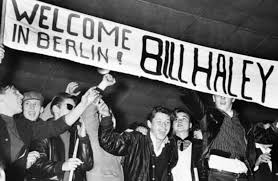
The furious authorities in West Berlin banned all rock concerts while East Berlin’s communist newspaper, Neues Deutschland, condemned Haley for “turning the youth of the land of Bach and Beethoven into raging beasts”. Haley had achieved the impossible – a rare moment of unity between the city’s two ideologically opposed halves.
Honecker – no deep interest in Marxist theory
Through the 1960s and 1970s, the GDR’s planned state-run economy provided full employment, welfare, free education and health but at the expense of democracy, human rights, and freedom of movement.
Unlike other communist leaders, Honecker felt no obligation to write voluminously on Marxist-Leninist theory. From a working-class background, he valued proletarian authenticity. His conversion to communism wasn’t a result of reading Karl Marx’s Communist Manifesto but just something he imbibed from his father and the coal mining district in which he grew up.
GDR Politburo member Hermann Axen (1916-1992) summed up Honecker’s view of communism: “What mattered to Erich was to have a roof over your head, enough to eat, warm clothing, sufficient money for a ticket to the movies on Saturday, and a condom.” Nothing about transforming society to the sunny uplands of genuine socialism where the state would wither away. There was to be no withering away of the state under Honecker.
A big part of the GDR’s state apparatus was the omnipresent secret police – the Staatssicherheit (State Security), known more commonly as the Stasi. It employed about 90,000 people with a vast surveillance network made up of countless more informers. This created a pernicious snitching culture where a wife might even betray her husband to the authorities, or vice versa.
In economic terms, the GDR was the most successful eastern bloc country. But compared to its neighbour, capitalist West Germany, it was far less impressive. The suffocating dead hand of Stalinist bureaucratic control stifled innovation and growth. Although East Germany’s communists had no intention of loosening their grip on power, they increasingly reached out to West Germany in the 1980s as an economic and trading partner.
The Soviet Union was nervous about East German leader Erich Honecker (1912-1994) meeting his West German counterpart Helmut Kohl (1930-2017). So, neither crossed the border to meet the other. But as one elderly Soviet leader after another died in the early 1980s, they were able to swap notes in Moscow. They chatted over the body of Yuri Andropov on 14 February 1984 and then over the body of his successor Konstantin Chernenko on 13 March 1985.
A few months later, in August 1985, Honecker scored a major PR coup over Kohl when West Germany’s intelligence chief, Hans Tiedge, defected to East Germany. Tiedge came to regret that decision when communism collapsed four years later and he was forced to flee to Moscow for the rest of his life.
While this was embarrassing for the west, it was the east facing the bigger crisis. Let’s countdown the last years of East Germany leading to its final collapse in 1990.
1985 – countdown to East German collapse
Key events:
- Mikhail Gorbachev becomes general secretary of the Soviet Communist Party
- GDR leaders reject Gorbachev policies of “glasnost” and “perestroika”
- Erich Honecker states that the political direction will not change
The countdown to the end of East Germany began with a big change in the Soviet Union. After years of stagnation under Leonid Brezhnev (1906-1982), and his two short-lived successors, Soviet living standards were low, economic growth was sluggish, there were food shortages, and Brezhnev had dragged the country into a hellish war in Afghanistan.
After the deaths of three Soviet leaders in rapid succession, the Politburo chose Mikhail Gorbachev (1931-2022) as the new general secretary of the Soviet Union. Not exactly youthful but in his fifties, which was an improvement. Gorbachev rolled out two radical initiatives: economic reform (perestroika) and openness (glasnost). This combined decentralisation and a relaxation on freedom of speech. In Berlin, Honecker was appalled.
For decades the GDR had slavishly followed every twist and turn of Kremlin policy – but not this time. That’s not to say that Honecker wasn’t looking for ways to revitalise his country’s flagging economy. But Honecker’s approach was to retain the GDR’s one-party state while reaching out to western partners to modernise the industrial sector and provide East Germans with the kind of consumer goods people in the west took for granted.
What he didn’t want to do was any relaxation in communist control. All mention of Gorbachev’s reforms was banned in the GDR. Life would continue as usual with no perestroika or glasnost. But the genie of change had been released from the bottle.
1986 – countdown to East German collapse
Key events:
- GDR suppresses information about the Chernobyl nuclear disaster
- 11th SED Party Congress rejects Gorbachev’s reforms
- Pressure groups become more open and active
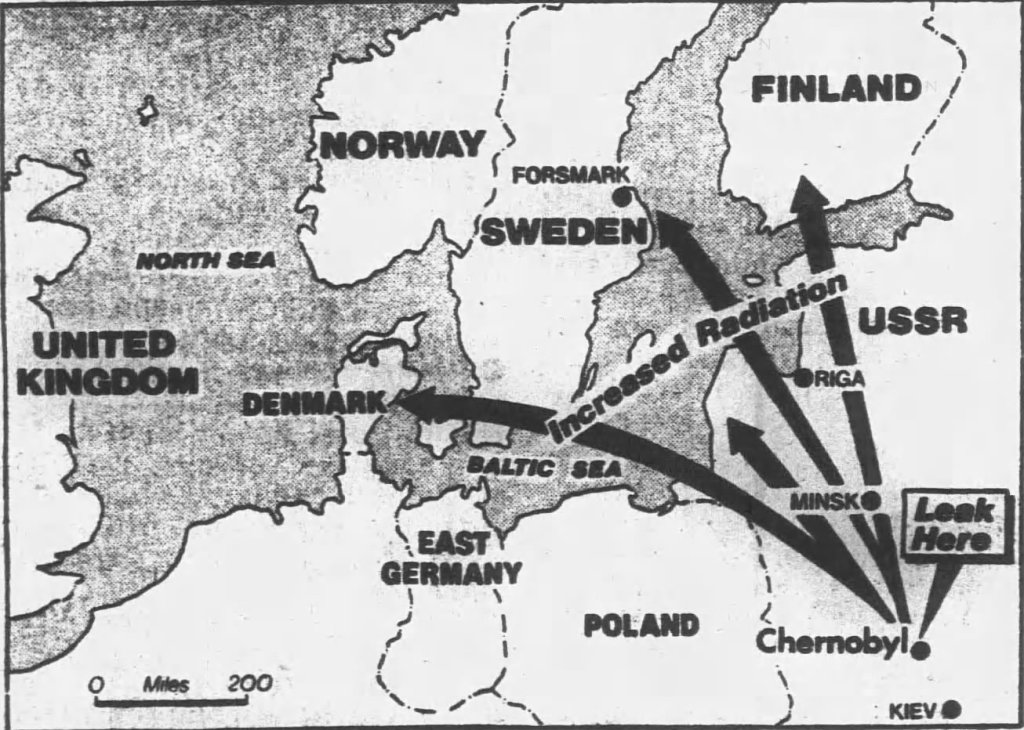
On 26 April 1986 the Chernobyl nuclear power plant at Chernobyl in Ukraine, then part of the Soviet Union, exploded releasing large amounts of radiation into the atmosphere. East Germany reacted in true Stalinist style. All information was suppressed.
Even as increased radiation blew across central Europe, the GDR told its citizens that no health risk was posed by events at Chernobyl. This was the 1980s and there was no internet or social media to consult, but East Germans were able to access western radio and TV. They discovered that the West German government was taking extensive precautions, giving advice to cope with the situation while the public in East Germany were being lied to.
1987 – countdown to East German collapse
Key events:
- Rock for Peace concert in Berlin ends in riots
- Honecker visits West Germany for the first time
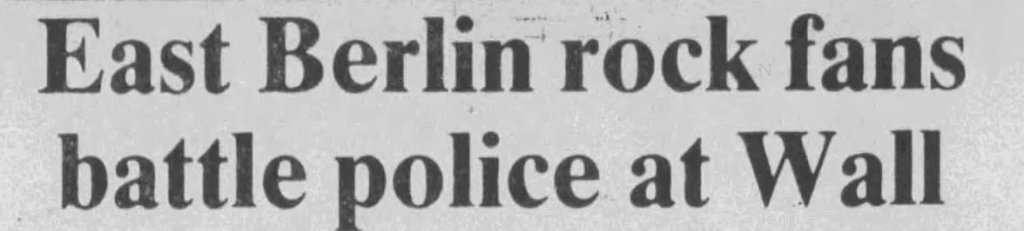
One of the most poignant incidents at this time involved a rock concert in west Berlin featuring David Bowie (who lived in west Berlin between 1976 and 1979), Eurythmics, and Genesis. Thousands of young East Germans converged near the Berlin Wall to hear the live music that was so tantalisingly close. They were beaten back from the wall by truncheon-wielding police.
In scenes that horrified the communist authorities, riots broke out near the Brandenburg Gate with stones and bottles lobbed at police. Chants of “Gorbachev!” and “The Wall Must Go!” filled the air.
A new generation was fed up of the 29-mile long, 14-foot high concrete barrier that had been erected by the communists to divide west and east Berlin – primarily to prevent East Germans leaving for West Germany. The Berlin Wall became the focus of increasing internal hostility towards the Honecker regime.
1988 – countdown to East German collapse
Key events:
- Official Luxemburg-Liebknecht parade features unofficial protest
- East Germans applying for exit visas in record numbers
- Ideological divide between Moscow and East Berlin widens
Every year, the GDR leadership held a massive parade to honour two leading German communists martyred in 1919: Karl Liebknecht (1871-1919) and Rosa Luxemburg (1871-1919). Up to 200,000 people, according to official sources, attended the 1988 event, which was televised. Party leaders were there to salute the loyal and obedient marchers, only things didn’t quite go as planned.
Protestors had infiltrated the proceedings and unfurled banners with quotes from Liebknecht and Luxemburg that reflected badly on what the GDR had become. One banner threw Luxemburg’s words back in Honecker’s face: “True Freedom means the Freedom to think differently.”
Police seized the offending banners and bundled protestors into vans. In the aftermath, about 80 of those taken into custody were thrown out of the GDR. The problem facing Honecker was that Gorbachev had set a new tone. Communists were being encouraged to ease up on internal dissent. The public in the eastern bloc were picking up on this and acting accordingly, but leaders like Honecker were determined to resist.
Something had to give.
1989 – countdown to East German collapse
Key events:
- Hungary opens its borders with Austria and East Germans flood across
- Leipzig demonstrations demand reform
- GDR 40th anniversary parades feature renewed protests
- Honecker replaced by Egon Krenz
- Berlin Wall falls
- The GDR parliament (Volkskammer) repeals the SED’s monopoly on power
1989 was the year that one communist dictator after another was toppled. In Berlin, the wall came down. East Germany had been the laggard when it came to change but that year it led the Warsaw Pact countries – the Soviet Union’s satellite states – in sweeping away all remnants of communism at lightning speed.
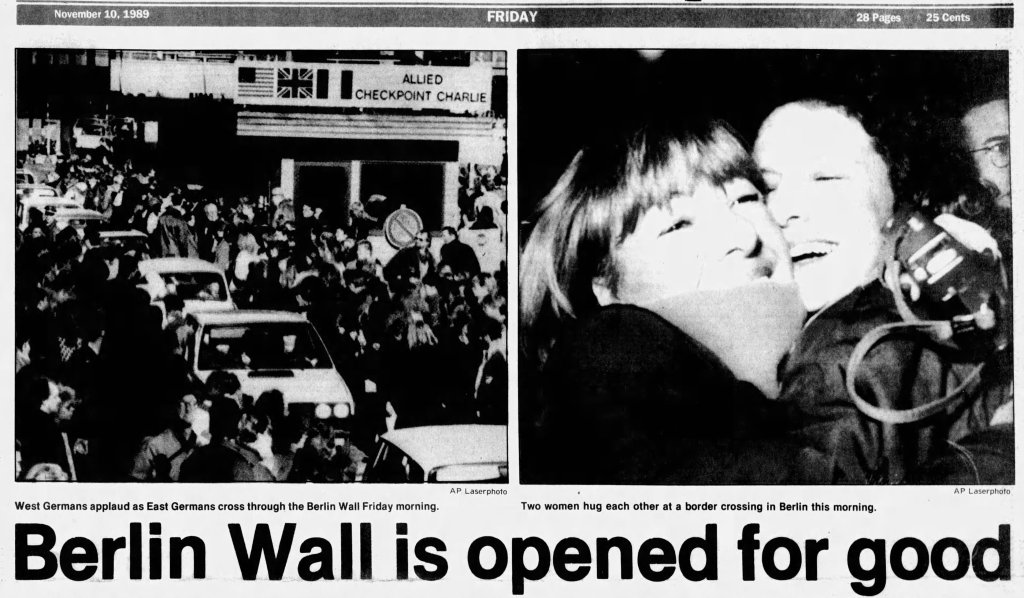
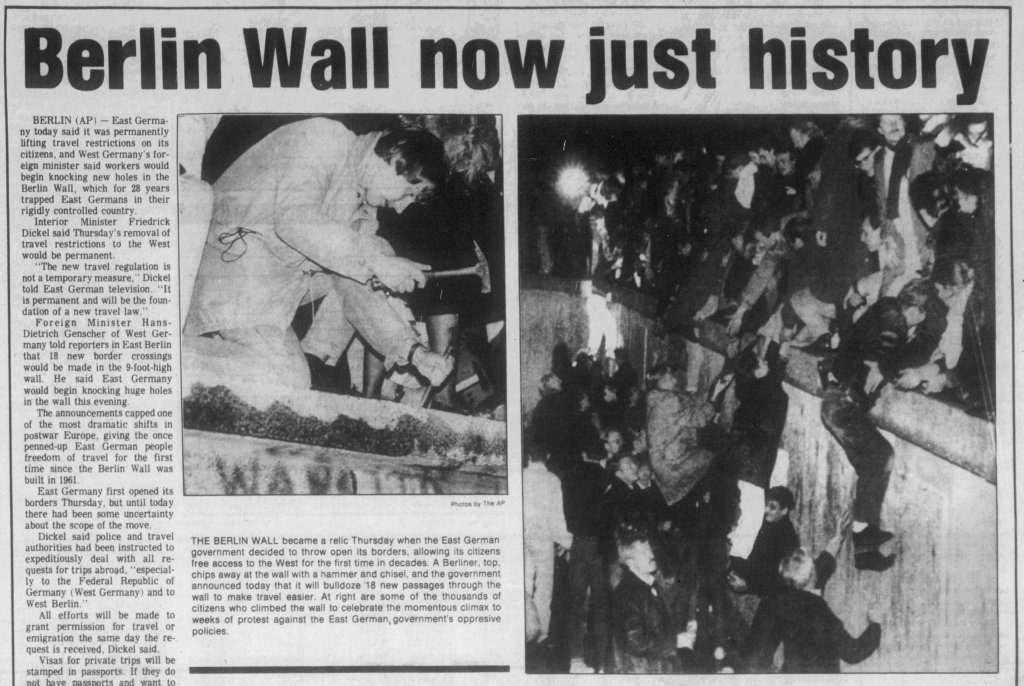
On 9 November 1989, the Berlin Wall became an irrelevance. Thousands of East Germans flowed westwards but for the United States and its allies, this disintegration of the GDR was as much a cause for concern as joy. President George H. W. Bush (1924-2018) even urged residents to stay put in East Germany and reform their country instead of trying to escape.
Young people in east Berlin were not listening. Travel restrictions, shoddy goods in shops, being stopped by police and asked for identification papers, and the constant presence of the Stasi secret police made life intolerable. Even though many workers had reasonable pay packets, they couldn’t spend their money.
Many watched American TV series like Dallas and Miami Vice and were convinced that this was the lifestyle they were missing out on. All of which begs the question: is this what Gorbachev wanted? The answer was an emphatic no.
The Soviet leader, who appeared shellshocked as the Berlin Wall fell, expected gradual phased reform overseen by communist parties in the Soviet Union and it’s European client states. He was reduced to issuing impotent warnings about dire consequences if the west imposed capitalism on the Warsaw Pact countries.
Honecker stepped down in October 1989, replaced by Egon Krenz. Viewed as a more conciliatory figure, he was still put on trial in the 1990s over the shoot-to-kill policy applied to East Germans trying to escape through the Berlin Wall before November 1989. He served a short sentence for manslaughter at Plötzensee Prison.
1990 – countdown to East German collapse
Key events:
- Stasi headquarters stormed
- Free elections in the GDR
- Unification Treaty between East and West Germany is signed
- GDR ceases to exist
In January 1990, thousands of East Germans stormed the headquarters of the Stasi – the secret police. They were especially keen to stop the systematic shredding and burning of records going on inside the huge building complex. A huge number of files were rescued, revealing the network of informers across the country. People in all walks of life were unmasked as Stasi agents.
It turned out that the Stasi had infiltrated the East German punk rock scene. There were entire bands made up of Stasi agents. A guitarist in one punk combo managed to get a bandmate jailed for anti-communist activity.
The total number of Stasi informers across the GDR remains a mystery with estimates anywhere between 200,000 and 500,000 people. Unsurprisingly, the East German parliament – the Volkshammer – was riddled with Stasi operatives, possibly up to 10% of the deputies were spies. As East Germany prepared for free elections, there were revelations of Stasi agents in all the main parties from social democrat to Christian democrat, undermining confidence in the new democracy.
Aftermath of the GDR’s collapse
As early as 1989, East German intellectuals were raising concerns about the future direction of their rapidly dissolving country. The sight of former GDR citizens walking the streets with West German shopping bags and slurping Coca-Cola was viewed as a degradation of their culture.
Worse was a growing sense among East Germans that they were being looked down on by West Germans, who viewed them as figures of fun. Aside from being called “Ossis”, meaning easterners, the former GDR was referred to as Dunkeldeutschland – dark Germany. Originally this was an observation on the much lower prevalence of street lighting in the east compared to the west. But since, it’s come to suggest that the ex-communist region is depressing and backward.
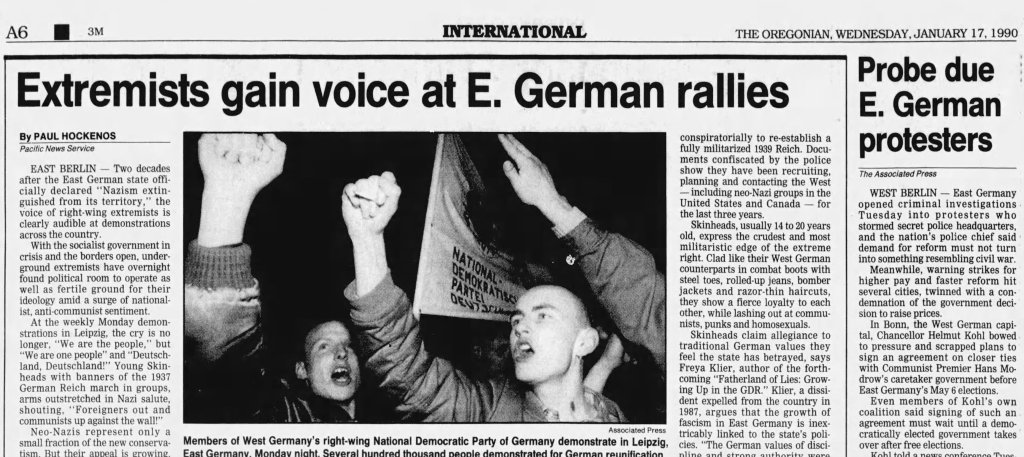
In recent years, the extreme-Right Alternative for Germany (AfD) party has done well in elections across ex-East Germany but it would be misleading to think that neo-fascist sentiments are a new phenomenon. Even under Honecker, there was a burgeoning neo-Nazi skinhead and punk scene.
In December 1987 a group of 17 to 23-year-olds were sentenced to prison terms for breaking up a concert in a church, beating up people in the audience, and shouting “fascist-terrorist slogans”. The customary blanket ban on reporting such incidents was lifted.
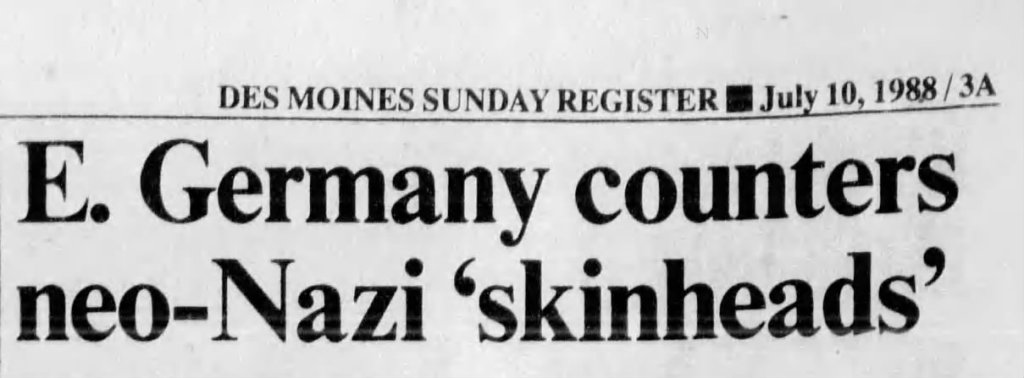
East Berliners were horrified when a 14-year-old Chilean schoolgirl was assaulted by five skinheads. Meanwhile, other neo-Nazis were engaging in another favourite thuggish pastime: toppling Jewish gravestones.
However, it’s important to point out that West Germany was also tackling a similar outbreak of neo-Nazi skinhead attacks. When the veteran Nazi Rudolf Hess (1894-1987) hanged himself in Spandau prison, West Berlin, at the age of 93, it stirred the Hitler lovers into action. Frankfurt police were able to foil a bomb attack at the city’s crowded main train station. In 1987, there were estimated to be about 23,000 extreme-Right activists in West Germany.
Yet it was East Germany where neo-Nazis felt there was fertile ground for recruitment and activity. As the Berlin Wall fell, youngsters squatted in run-down properties. Some were neo-hippies trying to recapture the 1960s vibe. But others were neo-Nazis whose gaze was fixed on the 1930s. The hippies and skins often clashed.
While extreme-Right parties made no headway in the 1990s, the situation has changed in recent years with disillusioned Ossis doing the unthinkable and putting their ‘X’ next to people the GDR once reviled.
Categories: History
 Marxism Explained
Leave a comment