
At the height of the Cold War between the Soviet Union and United States, in the 1950s, a communist state tried to throw off the Soviet yoke. Workers and students in Hungary began a revolution, hoping that the Kremlin would back off and let them decide their own destiny. But Moscow had no intention of letting Hungary choose its own path. The result was a bloodbath.
It all began with a speech that raised hopes for change. It ended with pitched battles between Hungarians and Soviet troops on the streets of Budapest. At the height of the uprising, secret police and pro-Russian Hungarians were lynched with their bodies hung from trees and lampposts. This is a forgotten episode from the 1950s. So, how did a communist country nearly break free from Russian control?
It started with a speech…
In 1956, the Soviet leader Nikita Kruschev gave a speech to the Communist Party congress in Moscow denouncing his predecessor, Joseph Stalin (1878-1953). Stalin had built a bloody personality cult, Krushchev thundered, and engaged in brutal purges of party officials. Kruschev’s incendiary words sparked short-lived pro-Stalin riots in Tbilisi, capital of the Soviet republic of Georgia where Stalin was born. The demonstrations were put down with hundreds of deaths.
However, the real headache for Kruschev wasn’t from Stalin’s supporters but from those who believed his speech gave them a green light for fundamental reform. Hungarians dared to imagine they could adopt the Yugoslav model – retaining communism but throwing off Russian control, now that Stalin – who had placed eastern and central Europe under Moscow’s heel – had been denounced.
Demands multiplied to get the Soviets out of Hungary. Kruschev was horrified. Hardline Stalinists, appalled by Kruschev’s speech, felt vindicated. His words had opened the floodgates to this anti-Soviet agitation. Thirty years later, hardliners would view Mikhail Gorbachev’s liberalising policy of glasnost in a similar, disapproving way.
Hungary’s version of Stalin, Mátyás Rákosi (1892-1971), had ruled the country since 1948. But as the clamour rose for change, even communists around Rákosi dared to criticise his rule. Suddenly, he fled Hungary for the Soviet Union, never to return. His replacement, Ernő Gerő (1898-1980), was an identical version of Rákosi, and only lasted three months, though he lingered like a bad smell throughout the uprising.
Students begin the Hungarian revolution of 1956
The 1956 Hungarian revolution began with students. They marched to the studio of Radio Budapest to make a series of demands on air. They called for:
- Soviet troops to be kicked out of Hungary
- Open and fair elections for posts in the ruling Hungarian Workers Party
- All those politicians associated with Rákosi to be dismissed
- Dissident Hungarian communist Imre Nagy to be put in charge
- National elections with multiple political parties, not just one, allowed to stand
- The way in which the economy is managed to be examined by specialists
- Minimum living wage for workers
- Freedom of opinion and expression
- Statue of Stalin to be replaced by the Hungarian martyrs of the 1848 revolution
- “Foreign” emblems for Hungary to be replaced by the 1848 emblem
The students hadn’t finish broadcasting their demands when they came under fire from within the radio building. The Államvédelmi Hatóság (AVH), which translates as the State Protection Authority, arrived to arrest the students. This was the equivalent of Russia’s KGB. In the hail of bullets, one student was killed. He was wrapped in a flag by his comrades and carried aloft from the building.
An insurgency was now sweeping Hungary and the old guard had lost control. Cities became war zones, resembling conditions during the Second World War. The AVH fired on protestors and killed hundreds. In retaliation, captured AVH agents were shot and hanged. There are some grim images of these lynchings.
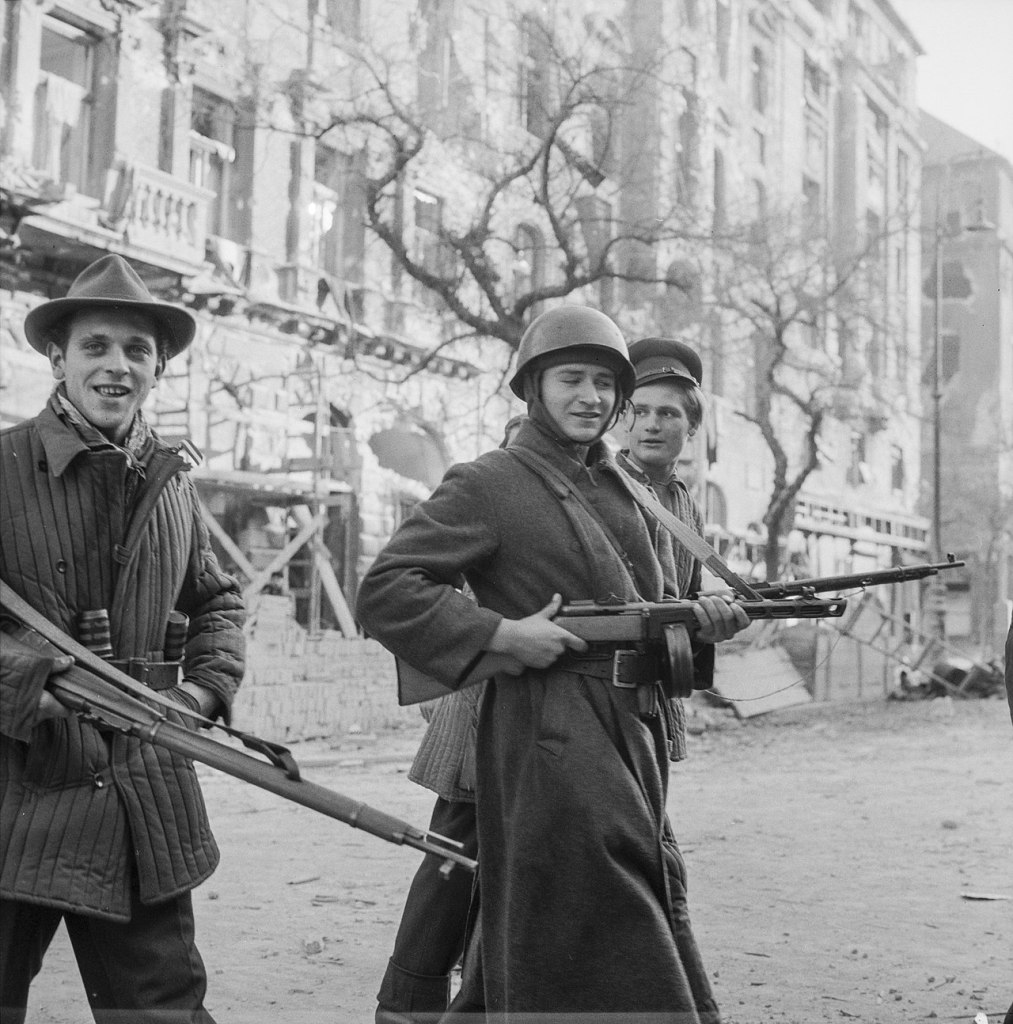
One analysis in 1956 divided up the warring factions inside the eastern bloc countries into the following:
- Committed Stalinists, normally party bosses prepared to continue taking orders without question from Moscow as they always had done
- Tito Communists who still believed in communism but wanted a degree of independence from the Soviet Union
- Anti-Russians were those who for historical reasons loathed Russian interference in their country’s affairs, regardless of whether it was the current communist regime or the pre-communist Russian empire
- Anti-communists who wanted to restore private property and capitalism and didn’t care if opposing communists were Stalinists or Titoists – both had to go
Hungary’s rebels included elements that wanted communism to work better and a looser relationship with Moscow as well as nationalists who opposed both Soviet domination and communism.
The Soviet Union acts to crush the Hungarian revolution
By late October, the Hungarian insurgency was in full swing. Statues of Stalin were toppled. Soviet propaganda materials were burned. To try and calm the situation, Moscow allowed Hungary’s ruling party to appoint a former prime minister, Imre Nagy (1896-1958), who had led the country between 1953 and 1955, before being dismissed and expelled from the party as a “Trotskyist traitor”. Well, now he was back. And the Soviets hoped he could nip the insurgency in the bud.
But Nagy was going to disappoint Moscow. Under pressure from the protest movement, and sympathetic to its aims, Nagy dissolved the AVH, allowed non-communists into the government, and withdrew Hungary from the Warsaw Pact group of European Soviet-aligned nations. This was too much for the Kremlin, which now sent in Soviet troops across the border into Hungary.
Political leaders in this kind of situation often appear like tragic characters in a Shakespearian drama. Nagy resembled Allende in Chile in 1973. His heart was with the protestors but he realised what was coming. One British newspaper in October 1956 described the hapless Nagy as looking “more like the churchwarden in a small Hungarian village community than the lifelong Communist party official he really is”.
Nagy was edging Hungary away from communism but the ruling party was still under the control of men like Ernő Gerő, who had no intention of relinquishing power.
On 25 October, Soviet tanks rolled down the streets of Budapest meeting stiff resistance. People were mowed down. Buildings were destroyed. The Soviet troops inside the tanks believed they were putting down a “fascist” or “reactionary” counter-revolution against the socialist state, supported by western powers. Some Soviet troops even imagined that Hungarian workers – the proletariat – would greet them as liberators. They were soon disabused of that notion.
Ernő Gerő had requested the Soviet intervention. The Russian troops were commanded by Georgy Zhukov (1896-1974), the Second World War Soviet commander and communist hero. So, while there was some fraternising between Soviet troops and Hungarian rebels, most believed they were there to bring Hungary back into the socialist fold.
The reality was pitched battles on the streets. About 3,000 people were killed and 20,000 injured. Nagy and other members of the government were arrested. For members of Communist parties around the world, this was a moment of reckoning. Many had turned a blind eye to Stalin’s purge of so-called Trotskyists in the 1930s and other atrocities.
But this proved too much to stomach for 300,000 members of the Italian Communist Party who tore up their party cards. Several leading intellectuals in the Communist Party of Great Britain quit though France’s communists seemed to emerge relatively unscathed, still commanding a quarter of the popular vote in French elections.
Reaction outside of Hungary to the revolution
Inevitably, Moscow sought to pin the blame for the Hungarian uprising on the west. Radio Moscow, Pravda, and Izvestia – the main media organs of the Soviet state – pointed an accusing finger at the United States, claiming it had launched a propaganda offensive to foment rebellion and helped to create reactionary underground networks.
Within the Soviet leadership, there had been differences of opinion on how to deal with Hungary. Kruschev and General Zhukov hoped that negotiations with the Hungarian leadership could resolve the situation. But Vyacheslav Molotov (1890-1986), a veteran Bolshevik, urged military intervention. His view prevailed.
A tough approach to the Hungarians was supported in China where Mao Zedong saw the uprising as a threat to the socialist system. It’s no exaggeration to say that events in Hungary had a profound, long term impact on the strategy of the Chinese Communist Party. Mao concluded that maximum unity was needed among socialist states; that China might be the country to lead the global socialist bloc in the future; and that the USSR’s ideological backsliding had created instability and an opening for anti-socialist elements.
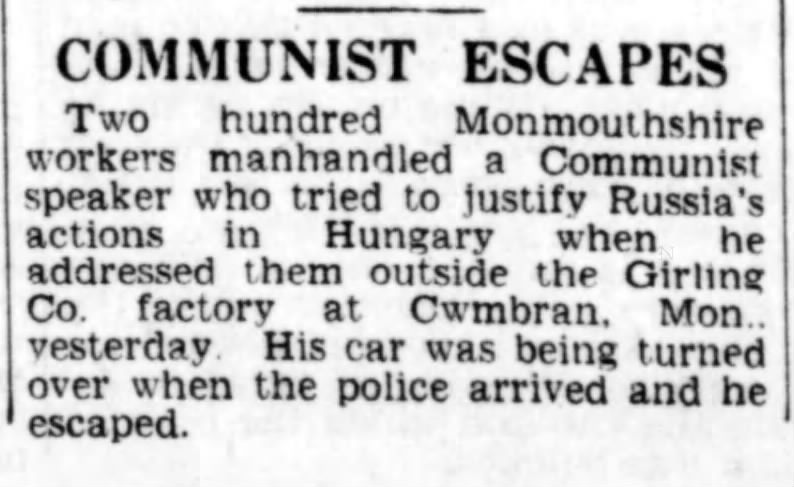
As they had done during the show trials of the 1930s, some Communists in the west sought to justify the Soviet clampdown on the workers’ uprising in Hungary. What they didn’t expect was that workers in their country would empathise more with their brothers and sisters in struggle and not the bureaucrats trying to suppress them.
The Daily Telegraph reported on one Communist coming under attack from 200 workers in Monmouthshire, south-east Wales, as he “tried to justify Russia’s actions in Hungary”. Police arrived as his car was being turned over on to its back. Communists like this, with their unquestioning support for the Moscow line, were referred to as “tankies”, especially by Trotskyists on the European left.
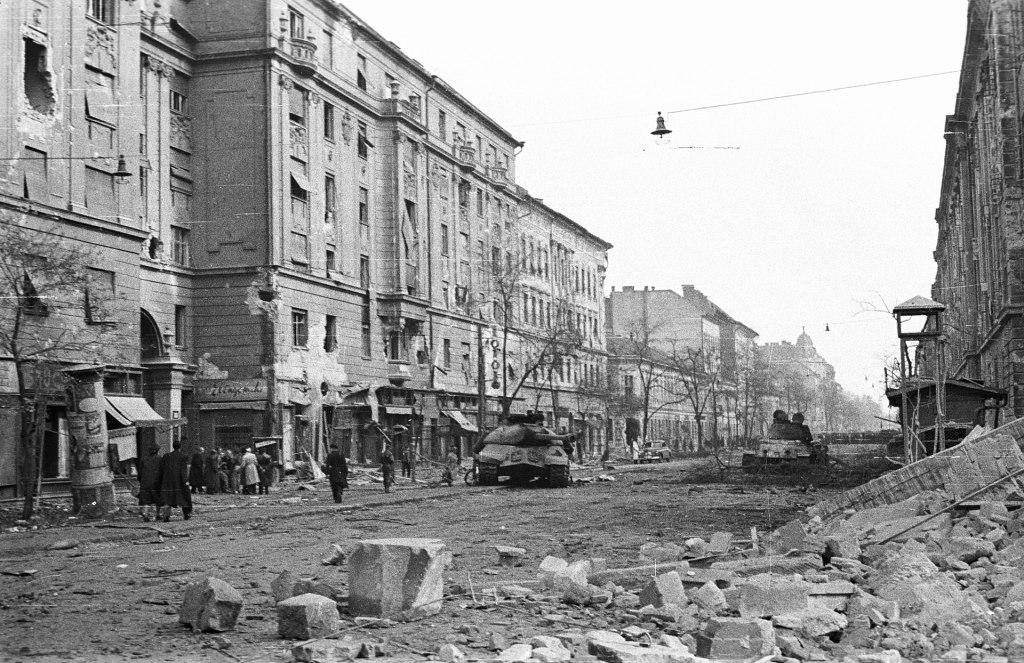
As the Hungarian revolution collapsed, the streets were left strewn with rubble. Thousands of families mourned their dead. Factory workers returned to the production lines. Students resumed their studies. But it was an uneasy peace.
Meanwhile, the hardliners took back control in Budapest under János József Kádár (1912-1989). Although he would later develop a softer touch ‘goulash communism’, mixing state planning with limited private sector activity, his initial actions in 1956 were classic Stalinist repression.
The end of Imre Nagy
With the Soviets and hardliners back in control, Nagy bolted for the Yugoslav embassy requesting sanctuary. However, he was lured out of the embassy on the pretext that his old comrades wanted to negotiate an exit strategy for him. But, once Nagy crossed the threshold, he was arrested.
Rumours circulated that he had been flown to Moscow for “re-indoctrination”. This was not true. Nagy was flown to Romania, another communist state, where he would remain until April 1958. Once brought back to Budapest, Nagy was put on trial, in secret, and then hanged.
In 1956, Poland had seen upheavals that resulted in Moscow granting a degree of autonomy. So why were Nagy and the Hungarian rebels dealt with so severely? A British journalist explained that while Poland had made it clear that it would remain solidly within the communist system, Nagy “had become more Magyar than Marxist”. He had stepped over a line, in the Kremlin’s view, and there could be no half-measures for him.
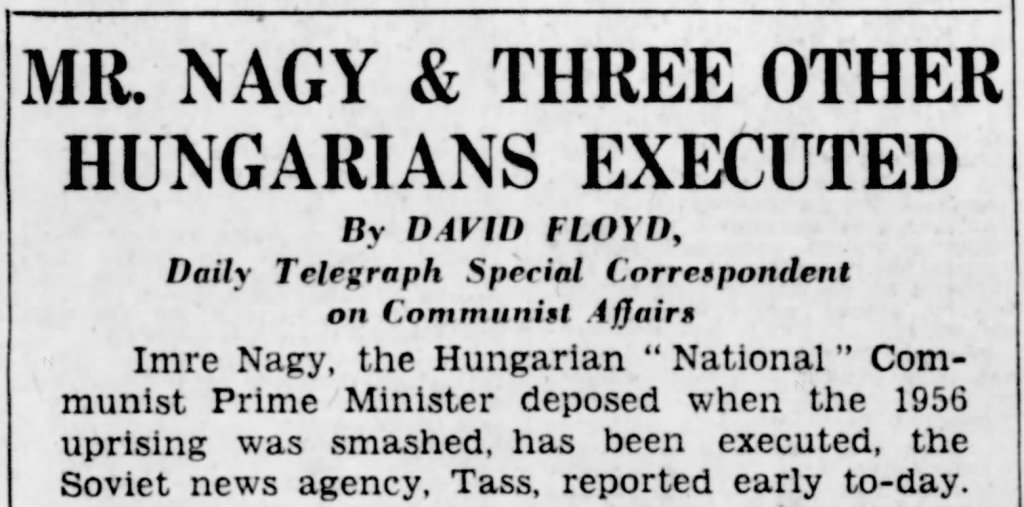
Nagy’s execution was announced in chilly terms in the Soviet press. It sparked a wave of revulsion around the world. There were the usual trumped up charges, the inability to mount any kind of defence, and the verdict a foregone conclusion. It echoed the treason trials of Tudor England or, of course, Stalin’s Russia.
The Daily Herald, a British left-wing newspaper, denounced Russia in the strongest terms with a large rally held in London, organised by the Labour Party and trades unions, to express solidarity with the Hungarian people. The Guardian newspaper declared that Nagy’s death ended any hope among communists around the world that they could operate without Kremlin interference.
In the decades that followed, anti-Stalinists and Trotskyists would mock Kremlin loyalists in western countries by calling them “tankies” for supporting the use of Russian armed force to put down the Hungarian workers and students uprising. Yet the tankies persisted until their world fell apart in 1989.
Categories: History


Leave a comment