
When communism collapsed, most of the former communist leaders from East Germany to Bulgaria slid into disgraced retirement or short spells in prison. Some went into the private sector, using their detailed knowledge to get rich. But one leader faced a firing squad – the Romanian dictator, Nicolae Ceaușescu (1918-1989). Let’s consider his life and ignominious death.
Like many of the eastern bloc’s top Stalinists, Ceaușescu was a lifelong communist, joining the party in his teens. The future Romanian leader came from humble peasant stock and was imprisoned in 1936 for communist activity. Just after leaving prison, he met Lenuța Petrescu, better known as Elena, who would become his wife and die alongside him in 1989 under a hail of bullets.
Ceaușescu and Romania’s king – similarities
To understand the kind of dictator Ceaușescu became, it’s worth looking at how King Carol II (1893-1953) governed Romania before World War Two. While most surviving monarchs in Europe were ceremonial figures, Carol grabbed political power and ran the country alongside his hated mistress, Elena Lupescu, who was dubbed the “Red Queen” on account of her fiery hair colour. The king, pictured below, created a personality cult around himself declaring he was God’s chosen sovereign.
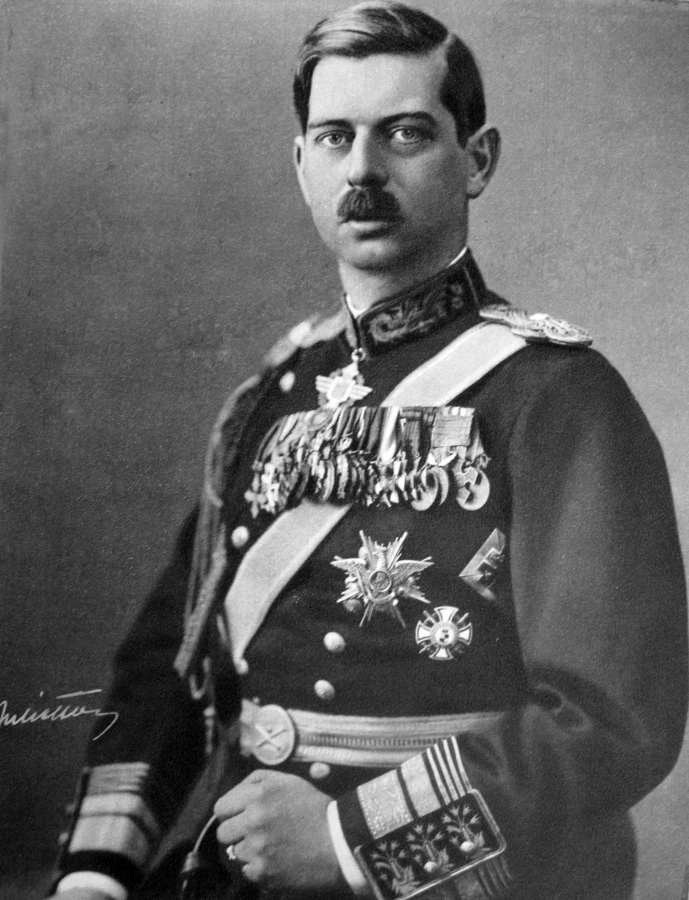
Carol styled himself the “Saviour,” “Voivode of Culture,” and “King of the Rebirth”. Here we can see similarities with the communist leader who ruled the same country decades later. Ceaușescu was hailed as the “Conducător” (Leader) and “The Helmsman.” One strongman wore a crown (Carol) while the other built an enormous palace for himself in Bucharest (Ceaușescu).
When King Carol was forced to abdicate in 1940, General Ion Antonescu assumed power under a puppet monarch as Romania moved into the Nazi orbit for the duration of World War Two. Hundreds of thousands of Romanian Jews were murdered in Hitler’s concentration camps while many Roma were also interned under appalling conditions.
The Communists take power in Romania
Ceaușescu spent the war in prison for his communist activities. Among the useful contacts he made was Gheorghe Gheorghiu-Dej (1901-1965) who would rule Romania before Ceaușescu.
As Nazi control over Romania crumbled, Ion Antonescu was overthrown in 1944 and the Soviet Red Army occupied the country. Romania’s communist party set about dismantling the opposition parties, snuffing out church influence, and setting up the notorious secret police: the Securitate. In 1947, King Michael I was forced to vacate the throne at gunpoint and a republic was declared.
While Gheorghiu-Dej had been in prison, Ana Pauker (1893-1960), pictured below with Gheorghiu-Dej, had acted as the party leader. She was sidelined though given the prestigious post of foreign minister. In fact, Pauker was the first woman of any country, communist or non-communist, to be appointed as a foreign minister.
Like Gheorghiu-Dej, she was an ultra-Stalinist who ran a notorious re-education program for political opponents – though some of them had been in the fascist Iron Guard, an organisation capable of inflicting its own kind of violence.
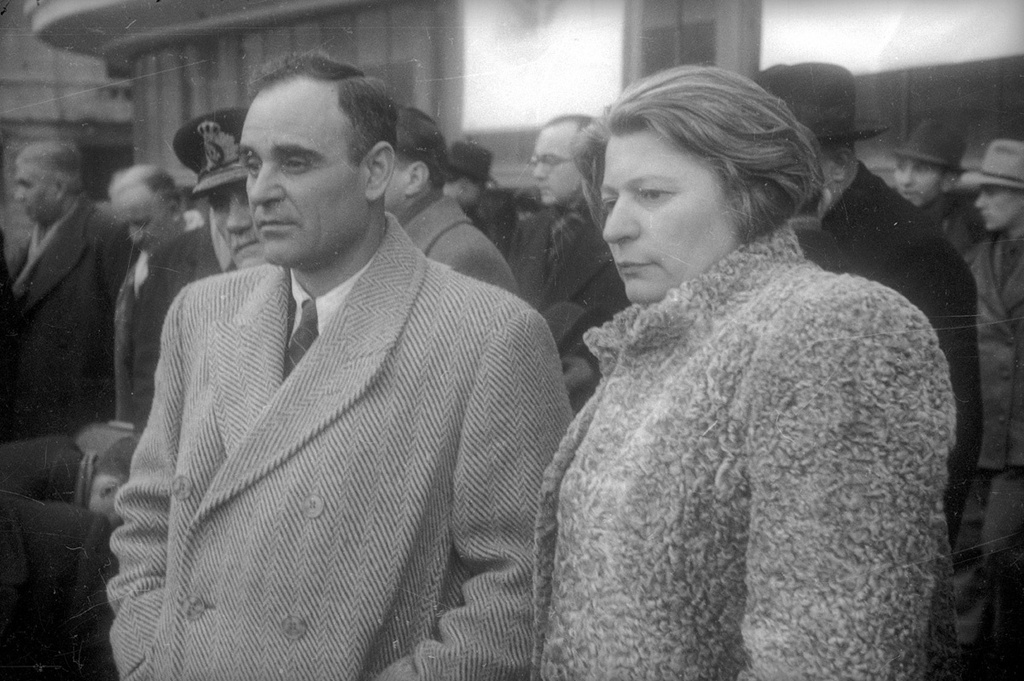
The first communist prime minister of Romania was Petru Groza (1884-1958) who was not, strictly speaking, a communist. But Gheorghiu-Dej and Pauker wanted to maintain the fiction of a broad-based coalition government representing the whole of the Romanian people. Groza complied. He was a tough operator whose support in the countryside was useful for the communists. It was allegedly Groza who held a concealed gun in his pocket and forced King Michael to sign his own abdication.
Romania moved decisively into the Soviet orbit. Groza stepped down in 1952, succeeded by Gheorghiu-Dej. He began the process of projecting a more “liberal” image to the west though what that meant in reality was less of a slavish posture towards Moscow while continuing hardline repression within the country. It was under Gheorghiu-Dej that Hungary’s deposed communist leader, Imre Nagy, was imprisoned within Romania in 1956 ahead of his execution by hanging on Soviet orders in 1958.
Ceaușescu takes power
When Gheorghiu-Dej died in 1965, his successor was the ambitious Ceaușescu who had clawed his way up the party ranks to the top. At his predecessors funeral, attended by Soviet and Chinese communist dignitaries, Ceaușescu made it very clear that Romania was intent on rejecting total absorption into the Soviet bloc and would retain a degree of independence without rejecting communism.
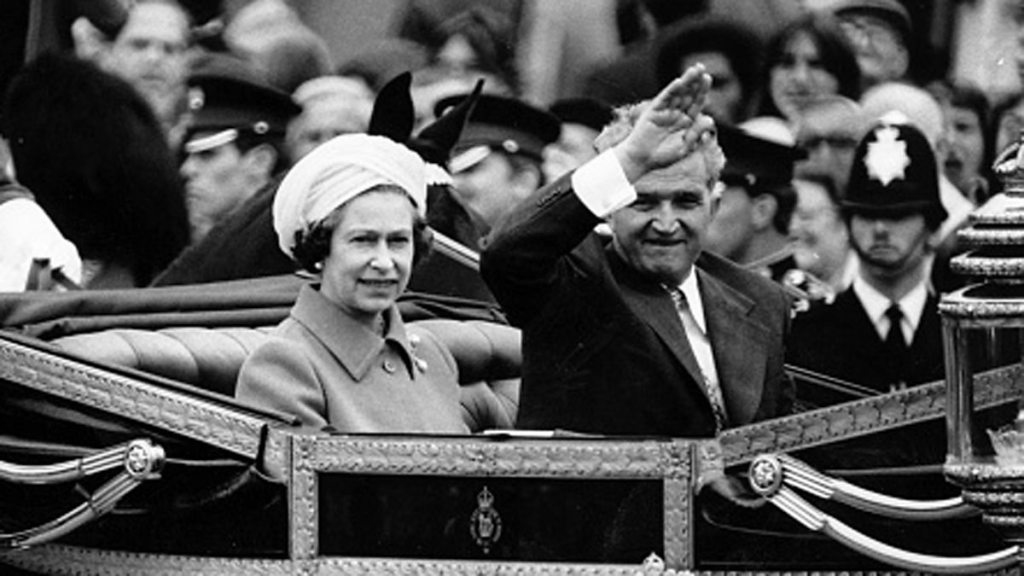
Aged 47, he was one of the youngest leaders in the Warsaw Pact family of communist nations and viewed in the west as a breath of fresh air. In London and Washington DC, Ceaușescu was the communist leader to cultivate. If he was prepared to needle the Kremlin, then the west would roll out the red carpet should he wish to visit. In 1978, Ceaușescu was cordially received by Queen Elizabeth II (pictured below) in London, accorded the pomp of a state visit.
In a brave, or rash, move, Ceaușescu extended the hand of friendship to the Czech leader Alexander Dubček in 1968, when Prague rebelled against Soviet control. Just a week before Moscow sent in Russian tanks, Ceaușescu flew to Prague offering Romanian solidarity to his Czech comrade.
It was touch and go whether the Soviets would send tanks into Romania and fearful that they might, Ceaușescu ordered a full-scale military mobilisation. Both he and Marshal Tito in Yugoslavia wondered if the Kremlin was now determined to crush all dissent across the eastern bloc. After all, he had called for the abolition of the Warsaw Pact. In the end, however, the Soviets focussed their fury on the Czechs and nobody else.
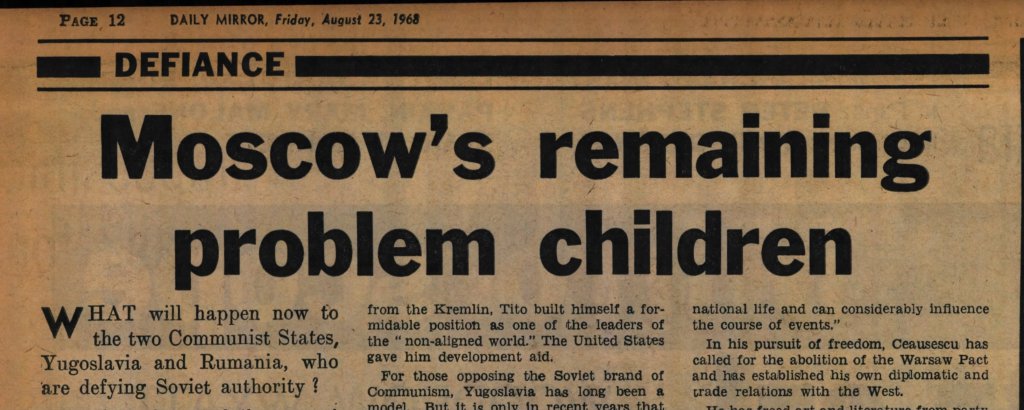
To the casual observer, Ceaușescu was a reforming leader sticking it to the Russians. He recognised West Germany; joined the International Monetary Fund; and met President Richard Nixon. But at home, within Romania, nobody thought Ceaușescu was a soft touch. Quite the contrary.
Personality cult and repression
After a visit to China and North Korea, Ceaușescu decided to implement his own version of Chairman Mao’s Cultural Revolution. The so-called July Theses in 1971 enforced a narrow version of socialist realism in the arts and clamped down on free expression.
After years of allowing the British pop singer Cliff Richard into the country, Romania’s communists told him to stay home. A planned discotheque in Bucharest with “stereophonic sound and psychedelic lighting” was scrapped by the authorities.
Ceaușescu had declared war on “cosmopolitan attitudes”. In factories, workers were told to scrub their lockers of any nude images. A new prudishness dictated that this would not be tolerated. One librarian complained that copies of The Three Musketeers had been removed as “adventurous western literature”.
Trying to make sense of what was going on, The Guardian newspaper in Britain noted that while all eastern bloc countries had a middling layer of ultra-Stalinist, reform-hating bureaucrats, it was far larger in Romania than elsewhere.
These people expected positions to be awarded on the basis of political loyalty and not expertise. For them, any whiff of reform, openness, or cultural freedom was a threat to their advancement. Therefore, Ceaușescu was bending to these party apparatchiks, enforcing political dogmatism.
From North Korea, Ceaușescu picked up the idea of introducing a personality cult. He was overawed by Kim Ill Sung’s total control over his society, rendering citizens into compliant zombies. Ceaușescu began to organise vast, synchronised displays where images of him and his wife, Elena, were held aloft.
He also began a programme of “Sistematizarea”, dense concrete urbanisation that swept away historic neighbourhoods and villages. The culmination of this was the extraordinary House of the People in the Romanian capital, Bucharest. It was the second largest administrative building in the world after the US Pentagon.
The downfall of Ceaușescu
The year 1989 saw the collapse of communism in eastern Europe, almost like a domino effect. In June, Solidarity – the non-communist trade union movement in Poland – won the parliamentary elections. Then Hungary opened its border to neighbouring Austria. November saw the Berlin Wall breached by protestors. Then came the Velvet Revolution in Czechoslovakia.
All of this was provoked by the reform programme of the Soviet Union’s leader, Mikhail Gorbachev. Like Kruschev, Gorbachev hoped that less repression and more liberality would help communism. But also like Gorbachev, he saw his reforms unleash an unstoppable desire for fundamental change.
As with Hungary in 1956 and Czechoslovakia in 1968, the Ceaușescu regime was unable to deliver economically to the people. Frustrated by hardship, food shortages, and repression, the city of Timișoara exploded into open revolt. Ceaușescu responded by gunning down protestors. Then he held a rally in Bucharest to bolster support from the party faithful.
Incredibly, on live TV, he lost control of the crowd as can be viewed below.
The rest, as they say, is history. I was in Geneva at Christmas 1989 when I watched the trial and execution of Nicolae and Elena Ceaușescu on French TV. They had been capturing while fleeing from Bucharest. A military tribunal was held in very ramshackle conditions, after which the duo were led outside and shot by a firing squad.
To the end, both seemed unable to process what was happening to them.
Categories: History
 Marxism Explained
Leave a comment