
The simple answer to the headline is – brutally. For barely two months in 1871, a radical socialist government took control of Paris determined to set up a working-class republic. Hardly surprising, the French ruling class decided that was a very bad idea and needed to be crushed. And so, the Paris Commune was drowned in its own blood.
The contemporary newspaper accounts are grim. Once Paris was back under the control of the regular French army, as well as the conservative government which had operated from Versailles while the commune was in control, the revenge killings got underway.
During the “Bloody Week” (la semaine sanglante) of 21 to 28 May 1871, up to 20,000 communards were executed. The report below in The Standard – a London paper – detailed how the insurgents surrendered, the revolutionary soldiers were disarmed, and communards were shot by firing squad “in batches of 50 and 100 at a time”.
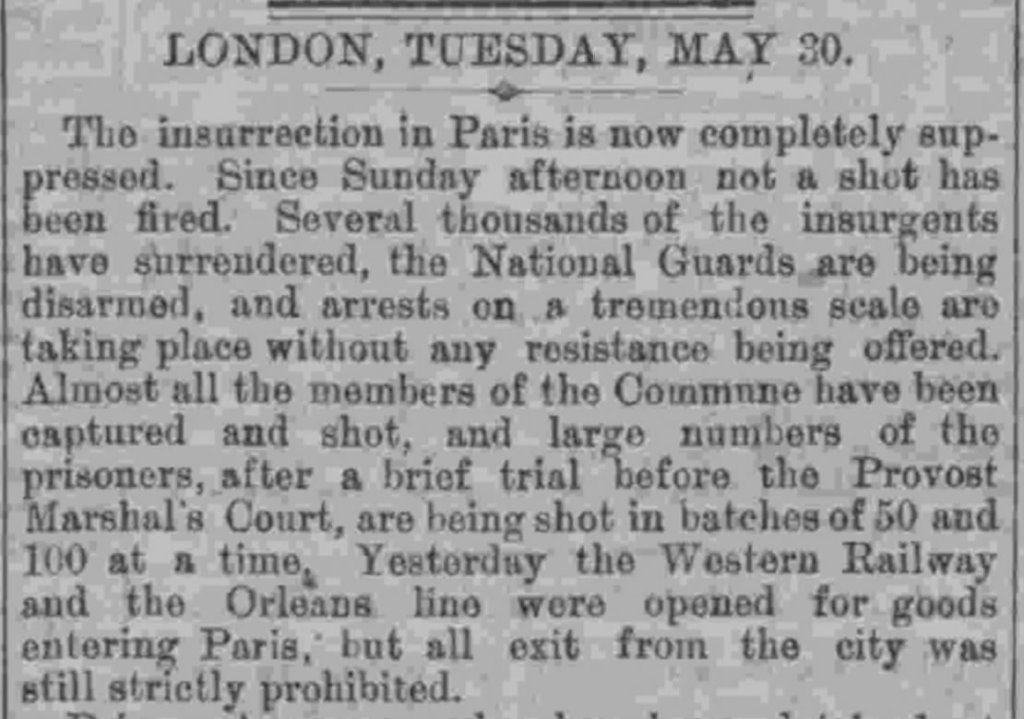
To this newspaper, Paris had descended into hellish lawlessness. “Every man with a musket in his hand has been a law unto himself, every woman with a phial of petroleum her own counsel and judge…Hundreds have surrendered only to be shot; thousands have fled only to be overtaken fleeing.”
What was the Paris Commune?
How did Paris end up going communist for two months in 1871?
In 1870, France had suffered a humiliating defeat in the Franco-Prussian war, often seen as a prelude for the First World War early in the next century. At the start of the conflict, the majority view among the French establishment was that Prussia could be soundly beaten. That proved to be massively wrong. As a result, the regime of Emperor Napoleon III – the Second Empire – collapsed.
Adolphe Thiers, a veteran French politician who had opposed the war against Prussia, took over the government. The Prussians arrived at Versailles for surrender talks and demanded humiliating peace terms. France had to pay Prussia huge sums and allow the Prussian army to hold a victory parade down the Champs-Élysées. This event went ahead in March 1871 with shops shuttered with sullen empty streets.
Parisians were bristling. They had been besieged by Prussian forces. Their government was grovelling to the enemy. And the city was hungry and angry – an ill-fated combination. Thiers arrived in Paris finding a city on the verge of revolution. There were 380,000 National Guard in Paris who hated his guts. Many of these Parisian troops had been exposed to communist and socialist propaganda and wanted radical change.
A horrified Thiers scuttled back to Versailles and began planning an invasion of his own capital. Meanwhile the city formed a “commune” – a working-class governing body – that demanded the separation of church and state; abolition of child labour; worker control over factories; remission of rents; and the election of all officials. Those officials would only be paid the wage of an ordinary worker.
The Paris Commune was elected by the people of the city on 26th March 1871. Meanwhile, Thiers was building up his forces in Versailles to take on the Parisian National Guard and the commune. He put Marshal Patrice McMahon in charge of the army that would crush this socialist experiment. I’m a McMahon myself and a distant relative – I regret to say.
McMahon – often spelt MacMahon – breached the Paris walls in the west and began a bloody march towards the centre from May 21st. During that month, the commune destroyed what it regarded as symbols of bourgeois and feudal power. The Vendôme Column was demolished, to the disgust of McMahon who told his troops it was an insult to their martial honour.
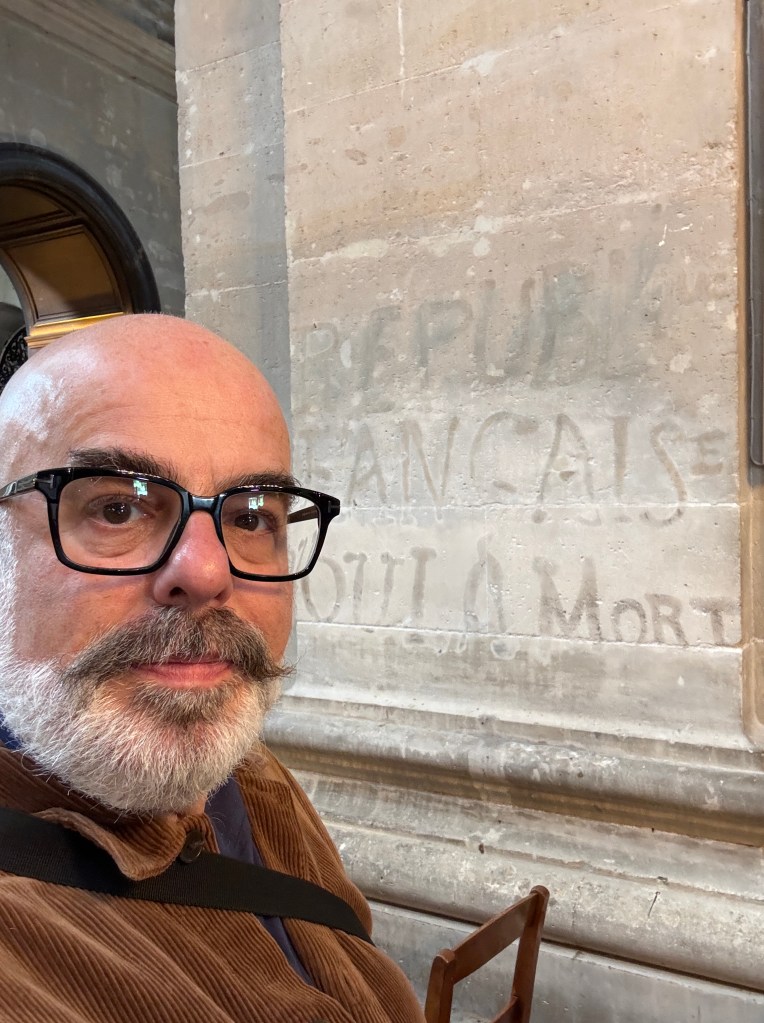
At one point, this pro-commune graffiti pictured below was painted on to a pillar in the church of Saint Paul and Saint Louis in the city’s Marais district. Here I am looking at it in September 2025. It reads République française ou la mort (French Republic or death) and despite numerous attempts by the Catholic clergy to wipe it away, the words have remained very legible. Possibly a communist miracle?
Why did it fall?
Given the numeric strength of the Paris Commune, in military terms, it’s surprising that they didn’t march on Versailles. As is so often the case in revolutionary situations, it wavered and divisions among comrades hampered clear decision making.
There were too many factions rowing continuously including Blanquists, Proudhonists, and various shades of socialist. Two other factors often cited for the commune’s defeat was the failure to take over the Bank of France, and use its assets for the defence of the commune, as well as a reticence to aggressively push forward into the rest of the country.
As a result, Paris became isolated. Possibly, the communards also underestimated Thiers and McMahon’s resolve to crush them completely as well as the role of the Prussians, who were now assisting their former foes to destroy this common enemy. Neither Prussia nor the Versailles government wanted communism.
By the time McMahon was within the city, it was too late. The war-seasoned marshal loathed any form of radicalism and showed no compassion. Many women were actively involved in defending the Paris Commune and McMahon’s soldiers had no qualms about executing both sexes in the streets.
One account in the Pall Mall Gazette recounted a husband and wife being forced to march to the Place Vendôme for their execution, alongside many others. The woman, weary and scared, sat down on a kerbstone and refused to walk another step, despite her husband pleading for her to continue. She clearly realised what was in store for them.
Both were described by the newspaper as “invalids” – whether they were injured or disabled wasn’t specified. The husband then knelt down with his wife and begged McMahon’s officers to shoot them on the spot.
“Twenty revolvers were fired but they still breathed, and it was only at the second discharge that they finally sank down dead.”
Another woman was in a group of 900 prisoners, walking defiantly, but every so often tried to escape. The same report in the Pall Mall Gazette stated that her captors got fed up of her attitude and fired a bullet into her heart, leaving her body in the street for some time. In fact, there seems to have been a deliberate policy to leave communist corpses lying around as an object lesson.
The communards were keen to stop their comrades being slaughtered by McMahon’s troops and threatened to shoot hostages they were holding – including the Archbishop of Paris, Georges Darboy. But McMahon and his bosses at Versailles pressed on leading to the controversial decision by the communards to execute the archbishop, which they did on May 24th. As in the 1789 French revolution, the church was viewed as a pillar of the reactionary state so taking out the top cleric in Paris had a certain logic.
However, Darboy was not an especially reactionary cleric – in fact he was disliked by the “ultramontane” faction within the church who gave slavish support to the overbearing Pope Pius IX. The archbishop opposed the pope’s declaration of infallibility, making it impossible to criticise the pontiff when he spoke on matters of faith. However, such considerations were of no interest to the communards, faced by a murderous enemy.
It’s worth pointing out in passing that being Archbishop of Paris was a rather dangerous job. Two of Darboy’s immediate predecessors had also been killed. Archbishop Denis-Auguste Affre was felled by a stray bullet during the 1848 revolution in Paris while Archbishop Marie-Dominique-Auguste Sibour was assassinated by a disgruntled priest, Jean-Louis Verger, who opposed celibacy for priests and the dogma of the Immaculate Conception.
What happened at the end of the Bloody Week?

Sunday May 28th was deemed to be the last day of the “red insurrection” in Paris. A flurry of telegrams gave final details with one noting that “the commune is dying very hard”. Holed up in Père Lachaise Cemetery cemetery, they fought with desperation among the gravestones before being forced to surrender and then lined up to be executed.
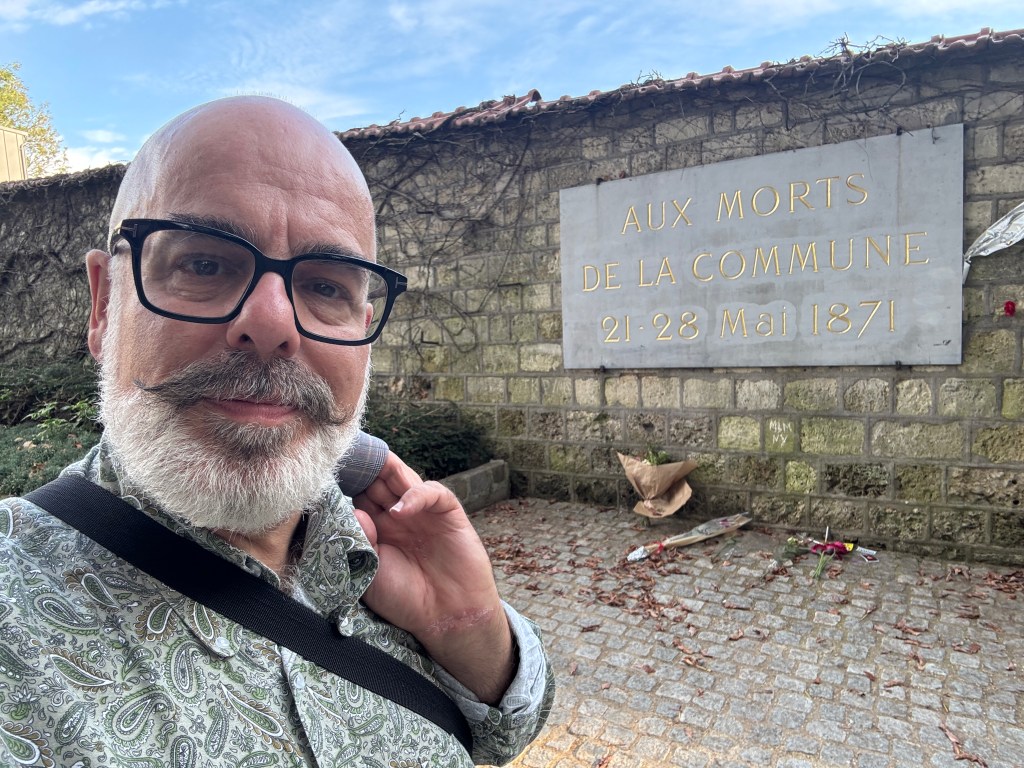
About 147 communards were shot at the spot where I took this image below on my smartphone during a visit to the cemetery in September 2025. The wall came to be known as the Mur des Fédérés. Nearby are the graves of leading figures in the French Communist Party.
By the evening of the 28th May, McMahon was proclaiming total victory in Paris. He would go on to become President of France.
Categories: History


Leave a Reply