
It’s a massively neglected historical topic and one that will fascinate anybody with an interest in Marxism. How Trotskyism grew in the United States, intervening in trade union disputes, falling out with pro-Stalin communists, fighting fascism, and having many run-ins with law enforcement. At the centre of this was the charismatic figure of James P. Cannon (1890-1974).
It’s a good time to look back at this. President Trump, in 2026, tried to whip up a new ‘red scare’, reminiscent of the anti-communist congressional hearings of the early 1950s. But it’s largely fallen flat. And more worryingly for the political Right, young Americans seem far less spooked by the words ‘socialist’ and ‘communist’ than was once the case. Times have certainly changed.
Travel back just under a century and fear of communism in America was at fever pitch. In 1917, Russia had become a communist state, rebranded as the Union of Soviet Socialist Republics (USSR). The following year saw an attempted communist uprising in Germany. The American establishment feared that industrial workers could become infected by communist ideology and took determined action against those spreading Marxist ideas or organising strike action.
James P. Cannon – the American Lenin
Surveying America’s post-Second World War history, it would be easy to dismiss the history of communism in the United States as a fringe movement. But Leon Trotsky (1879-1940) had high hopes for a revolution there and James P. Cannon would be the American Lenin.
Trotsky viewed Cannon as a trusted collaborator with whom he enjoyed a strong correspondence. Their association began with the Sixth Congress of the Communist International in Moscow in 1928. Cannon attended, representing the Communist Party USA (CPUSA). At this time, he was viewed by the Kremlin as a loyal comrade.
By this year, Trotsky had already been expelled from the party in the USSR and exiled internally before being kicked out of the Soviet Union in 1929. Stalin was tightening his grip on both the communist party within the USSR and allied parties around the world.
Kansas-born Cannon joined the reformist Socialist Party of America (SPA) after the Russian revolution, aligning himself to the ‘Left Wing Section’, which urged a revolutionary break with capitalism. The inevitable split came in 1919 with the formation of the Communist Labor Party. By 1920, Cannon was on the Central Executive Committee.
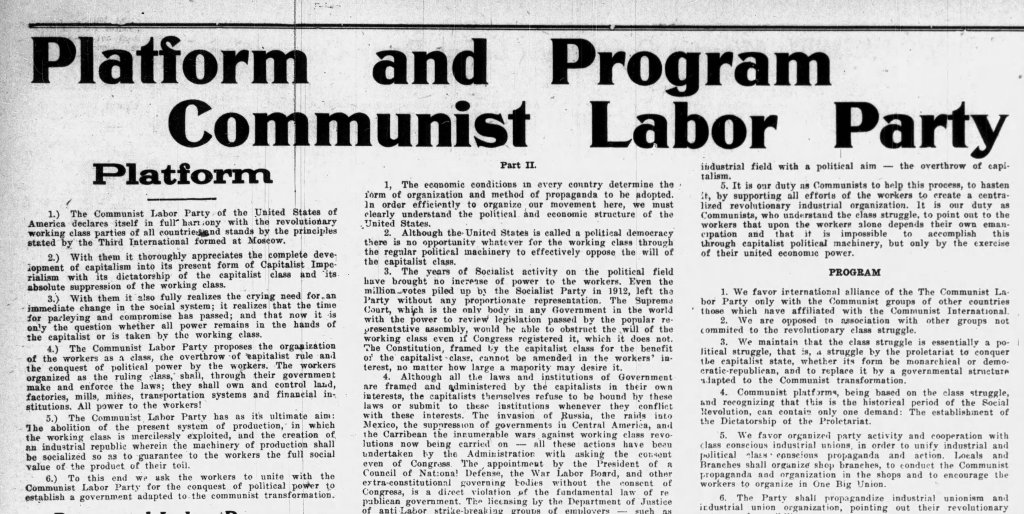
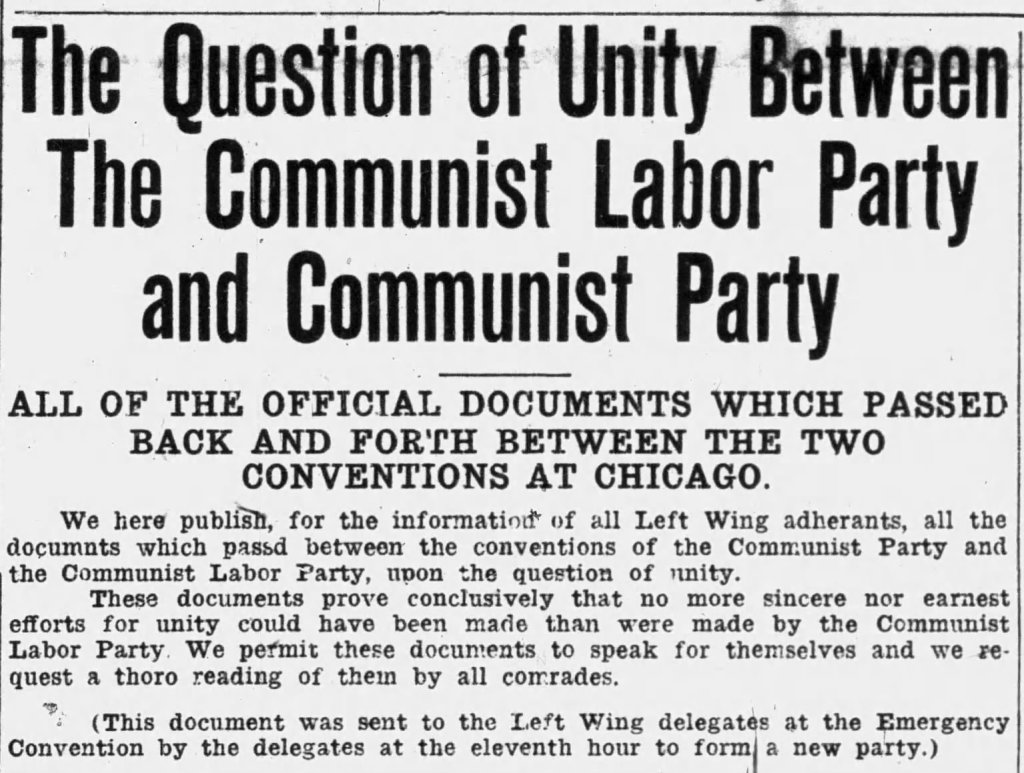
In fact, there were two split-offs from the SPA. The new Communist Party (CPA) took the foreign language sections of the SPA and was reputedly more centralist in organisation and rejected co-operation with reformist groups.
While the Communist Labor Party was focussed on trade union activity with a larger English-language base. This disunity was unwelcome in Moscow and the Comintern (Communist International) demanded unity – so the two parties merged in 1921 to form the Communist Party USA (CPUSA).
Red Scare sweeps America – ‘Palmer Raids’
The years 1919 to 1921 witnessed the first major ‘Red Scare’ in the United States. Communists were characterised as rebels – fomenting rebellion and treason. Worth remembering that the American Civil War had ended 55 years before and the memory of the Confederate insurgency was still raw.
Add to that decades of clashes in American factories and the wave of anarchist attacks in the early 20th century (including the assassination of President McKinley in 1901) and it wasn’t difficult to get respectable opinion alarmed over the threat of communism.
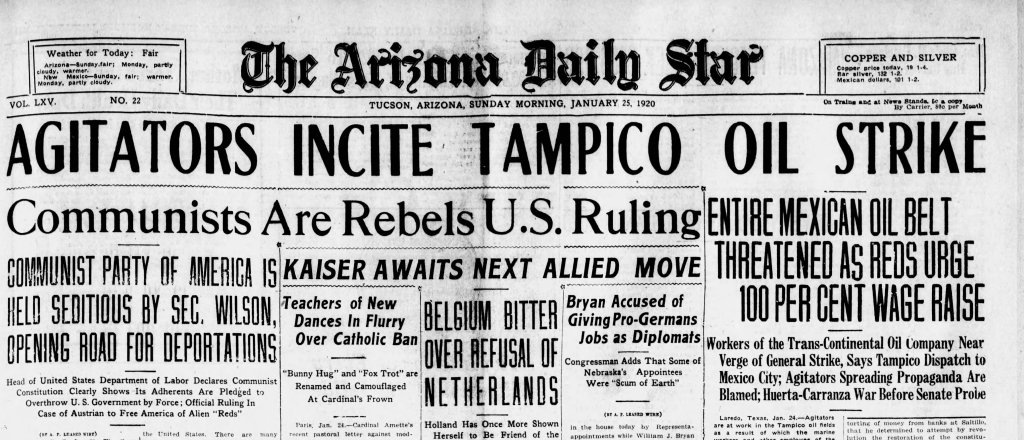
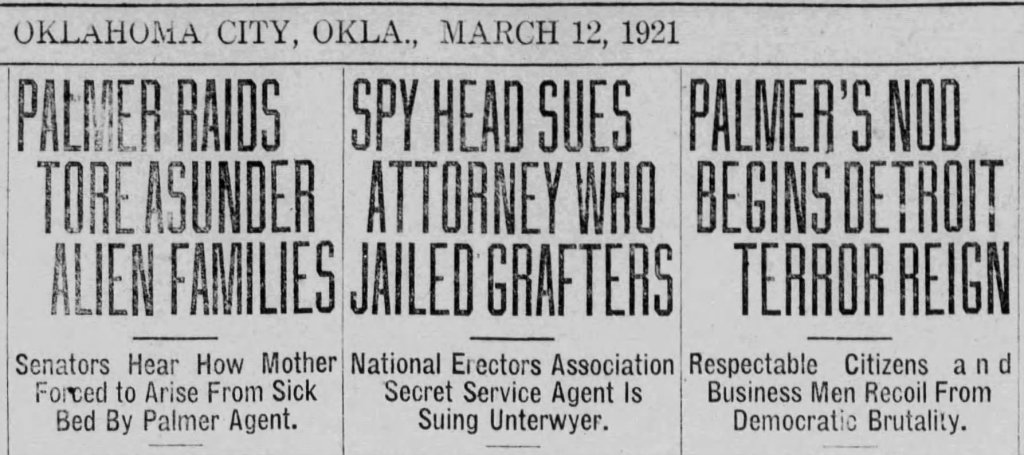
While legislators hesitated to make membership of communist organisations illegal, they found an easy weapon to hand to remove part of the problem: deportations. Thousands were arrested as illegal aliens but ultimately only about 556 were expelled from the country. The so-called Palmer Raids are hard to ignore as a forerunner of recent raids by ICE (US Immigration and Customs Enforcement).
Spearheaded by US Attorney General A. Mitchell Palmer (1872-1936), these ‘red raids’ were intended to ‘break the back of radicalism’ with Palmer ordering agents to ‘raid and keep on raiding until it is broken’.
Cannon expelled from the CPUSA
At the 1928 congress in Moscow, Cannon was handed a critique of Stalin authored by Trotsky. He immediately agreed with the analysis and returning to the United States began organising a Trotskyist grouping within the CPUSA. This would be prove to be a momentous year for Cannon. In the early months, he was still viewed as a loyal comrade, touring American cities in his role as a leading party official.
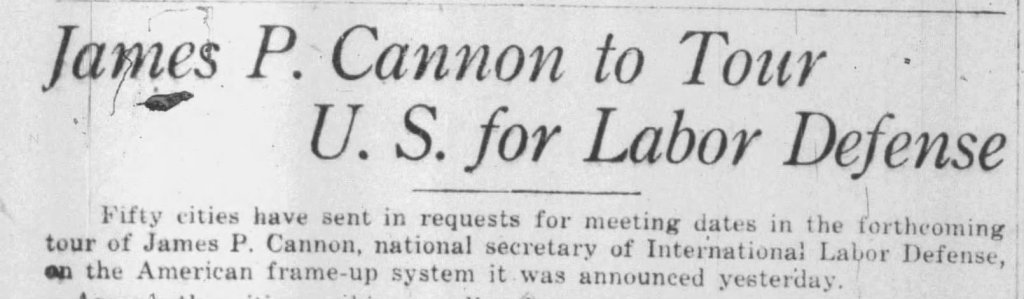
An external commentator, writing in 1958, noted what happened next to Cannon:
‘The Communist Party USA acting under Comintern instructions conducted its first big purges. James P. Cannon, another of those purged in the late 1920s, was expelled for possessing Trotskyite tendencies, a reflection of the CPUSA’s adherence to Stalin in the Trotsky-Stalin struggle for power in Russia.’
The author of those words: J. Edgar Hoover (1895-1972). The man who founded and led by the FBI (Federal Bureau of Investigation) from 1935 to 1972. A fervent anti-communist who served under every US president from Calvin Coolidge in the 1920s to Richard Nixon in the 1970s.
Cannon was thrown out along with Max Shachtman (1904-1972) and Martin “Marty” Abern (1898-1940). The three formed the Communist League of America in 1928, the first organised Trotskyist current in the country. To articulate its opposition to Stalinism, the league published The Militant, which included regular contributions from Trotsky, now wandering the earth, condemned to external exile.
It was tiny — a few hundred members — and spent its early years as an ‘expelled Communist’ faction, publishing The Militant and trying to influence the CPUSA from outside rather than building an independent mass party.
At around the same time, another faction loyal to the ideas of Nikolai Bukharin (1888-1938) was also expelled from the CPUSA). Bukharin was the leader of what Stalin dubbed the Right Opposition within the Soviet Union. In the United States, his leading supporter was Jay Lovestone (1897-1990) who would later become a CIA informant and determined anti-communist.
By 1930, the American Bukharinites were publishing The Revolutionary Age and along with the ‘Cannonites’ routinely referred to their former home, the CPUSA, as ‘Stalinists’. Both factions needed to make a political, even psychological break from the CPUSA. As the grim truth about Stalin became clearer – with brutal purges in the USSR – the break was easier to make.
The Socialist Workers Party and the French Turn
Through the 1930s, the group tested a series of tactical alliances. In 1934 it merged with the American Workers Party, formed by a Dutch-born pacifist pastor, A J Muste (1885-1967). In the same year, the Minneapolis Teamsters strike saw Cannon and his party play a leading role in that struggle. For the American Lenin, it demonstrated how Marxists could successfully interact, even play a leadership role, in labour disputes often led by more conservatively inclined trade unions.
Then in 1936, Cannon recommended to his Workers Party that they end their status as an independent political party and enter the Socialist Party of America. This was described as the ‘French Turn’ because two years earlier, Trotsky had instructed French Trotskyists to enter the French Socialist Party (SFIO).
The Nazis had taken power in Germany, crushing workers’ organisations, socialists, and communists. Stalin’s idiotic policy between 1928 and 1933 of dubbing socialists as ‘social fascists’ had created disunity, even violence, on the Left, helping fascism take control.
Fascism now controlled Portugal, was fighting the democratic government in Spain, and had seized power in Italy a decade before. Stalin pivoted to a ‘popular front’ position while Trotsky recommended what outsiders might unkindly call infiltration. It would be a short-term tactical raid, recruiting the best cadres and youth within the far larger socialist party. Then break away when mission accomplished.
By 1937, when Cannon’s group was expelled from the Socialist Party – they had increased their membership and taken control of the Socialist youth wing. In the following year, they formed the Socialist Workers Party (SWP), which would remain the dominant organization of American Trotskyism for the next four decades.
The First Great Split: Shachtman and the “Russian Question”
The SWP’s unity did not survive the decade. In 1939 and 1940, a bitter internal debate broke out over how to characterise the Soviet Union following the Hitler-Stalin Pact and the Soviet invasion of Finland.
Cannon held to the orthodox Trotskyist position that the USSR remained a “degenerated workers’ state” deserving critical defense. Max Shachtman, backed by the writer and philosopher C.L.R. James (writing as J.R. Johnson) and others, argued that Stalinist Russia had become a new form of class society — “bureaucratic collectivism” — that revolutionaries owed no loyalty to at all.
Trotsky himself intervened from exile in Mexico, siding with Cannon. Shachtman’s faction left anyway, taking a substantial share of the SWP’s youth membership with them to form the Workers Party in 1940. It was the first of what would become a defining pattern: doctrinal disputes over how to characterise Stalinism, translated into permanent organizational fractures.
Shachtman’s own trajectory afterward is one of the stranger arcs in American left history. His group evolved into the Independent Socialist League and eventually merged into the Socialist Party, with Shachtman himself drifting rightward over the following decades until he ended up supporting the Vietnam War and mentoring a generation of intellectuals — including figures who would later become ‘neo-cons’.
Neo-conservatism has been referred to as ‘inverted Trotskyism’ with some justification. Trotsky rejected Stalin’s ‘socialism in one country’ and believed Marxism had to be constantly ‘exported’. Neo-cons perverted this into a continuous and uncompromising spread of American-style liberal democracy across the globe.
One ‘permanent revolution’ replaced by another.
Cold War Pressure and the 1953 Split
The SWP spent the McCarthy era under sustained federal pressure, prosecuted under the Smith Act in 1941 for advocating the overthrow of the government — the first use of that law against a domestic political organisation, predating its more famous use against the CPUSA later in the decade.
A second major rupture came in 1953, again over how to read events in the Communist world, this time centered on the death of Stalin and unrest in Eastern Europe. A faction led by Bert Cochran 1913-1984) and George Clarke (1913-1964) broke away, arguing that the SWP had become too isolated and sectarian and should orient toward the existing labor movement rather than maintain a small propaganda party.
They left to found the American Socialist Union, which dissolved within a few years — a fate that would recur often: splinters that broke off in protest against isolation, only to isolate themselves into non-existence.
The Fourth International Fractures Globally
These splits mirrored a bigger one happening internationally. The Fourth International — the global federation Trotsky had founded in 1938 to rival the Comintern — split in 1953 into competing “International Committee” and “International Secretariat” tendencies, largely over how to relate to Third World anti-colonial movements and Stalinist parties in Europe.
American groups aligned themselves on both sides of that divide, and those international allegiances would go on shaping (and re-shaping) US Trotskyism for the rest of the century.
The New Left Era: Growth and New Divisions
The 1960s and early 1970s were the SWP’s high-water mark. Opposition to the Vietnam War gave the party a genuine, if modest, mass audience: it played a significant organizing role in early anti-war coalitions, and its 1970s presidential campaigns, with candidates like Linda Jenness and Peter Camejo, reached tens of thousands of voters. Membership peaked at around two thousand.
It was also in this period that Trotskyism became a real current on American campuses for the first time, and new organizations sprang up to its left and right. The International Socialists (IS), founded in 1969, drew on the old Shachtmanite tradition and emphasized “rank-and-file” labor organizing over electoral politics.
Workers World Party split from the SWP in 1959 over the Hungarian Revolution and the Cuban Revolution, taking an even more favorable view of existing ‘actually existing socialist’ states than the parent party did — a position that would itself later split, producing the Party for Socialism and Liberation in 2004.
The SWP’s Turn to Castro — and Implosion
Beginning in the late 1970s, the SWP’s leadership under Jack Barnes (born 1940) concluded that the Cuban Revolution represented a genuinely socialist path more relevant to the modern era than the party’s own Trotskyist orthodoxy, and began explicitly downplaying Trotsky’s theoretical legacy in favor of a Castro- and Nicaragua-oriented “turn to industry.”
Longtime members, including some who had known Trotsky’s own collaborators, were expelled or resigned in protest through the 1980s. The SWP that exists today is a small remnant of its former self, still publishing The Militant but bearing little resemblance to the mass-oriented party of the Vietnam era.
Where Things Stand Today
The result of ninety years of splits is a landscape almost too fragmented to summarize cleanly, but a few threads are worth naming:
- Socialist Workers Party — the original organisation, much diminished, still active.
- Socialist Equality Party — descended from the International Committee tradition, known for the World Socialist Web Site.
- Solidarity — formed in 1986 from a merger of several smaller groupings, including descendants of the IS tradition.
- Party for Socialism and Liberation and Workers World Party — both well outside strict Trotskyist orthodoxy today, but genealogically part of this story.
- Numerous small propaganda groups, often numbering in the dozens, each claiming to represent authentic continuity with Trotsky’s program.
Why It Kept Splitting
It’s tempting to read this history as evidence that Trotskyists are simply unusually quarrelsome. But the deeper pattern is structural: a movement built around correctly diagnosing the class character of faraway states — the USSR, China, Cuba — will keep splitting every time one of those states does something that doesn’t fit the existing analysis.
What’s more remarkable than the splits themselves is that any organised current survived them at all — nearly a century after Cannon smuggled that document out of Moscow, there are still Americans publishing newspapers in Trotsky’s name.


Leave a Reply