
How has society moved on from the slave states of the ancient world to medieval feudalism and then on to industrial capitalism and where we are today? Well, Karl Marx described the process through his theory of historical materialism. Don’t be scared – it’s not that difficult to understand.
Let’s go right back to the dawn of human history and we have hunter gatherers foraging to survive each day. The idea of social class was entirely alien. Indeed, any individuals hoarding food needed by the group would have been frowned on or worse. Hard to describe this as ‘communism’, more an egalitarianism imposed by circumstances.
There was no private property, permanent hierarchy, or social class. This notion of primitive communism has fascinated many archaeologists who have noted a cooperative ethos in prehistoric groups. There is evidence of some private property but this was at the level of stone tools. While anthropologists have long wondered whether the capitalist concepts of competition and selfishness really are inherent to humans or a later development.
But all good things must come to an end and at some point, these communities began to generate an economic surplus. The Neolithic agricultural revolution brought about a more sedentary existence in villages with the population turning to farming. This generated a surplus of produce that went from being managed to owned by a distinct class within society.
These owners of the surplus became both political and military leaders as well as priests. Palaces and temples were built using the surplus and a layer of society divorced itself from daily toil. Specialised roles such as warriors, priests, and administrators emerged as society became more sophisticated but also stratified.
Karl Marx never suggests that this process could have been avoided. Rather the development of class went hand in hand with the emergence of a surplus but at some future point, social class would become a constraint on human development that would need to be removed.
At the same time that social class became entrenched, so did a growing division of labour. Whereas in early human society, everybody did a bit of everything, more developed societies saw people attach themselves to necessary activity like pottery or metalworking. Inequality and segmentation were further solidified by inheritance. The rich passed on their goods to the next generation, shutting out everybody else. While trades moved through families.
The elite were engaging in what Marx termed ‘primitive accumulation’, charging rents to farmers and levying taxes and enforced labour. This divorced those who worked from the means of their own production. They know longer owned their own daily activity. It was the property of somebody else.
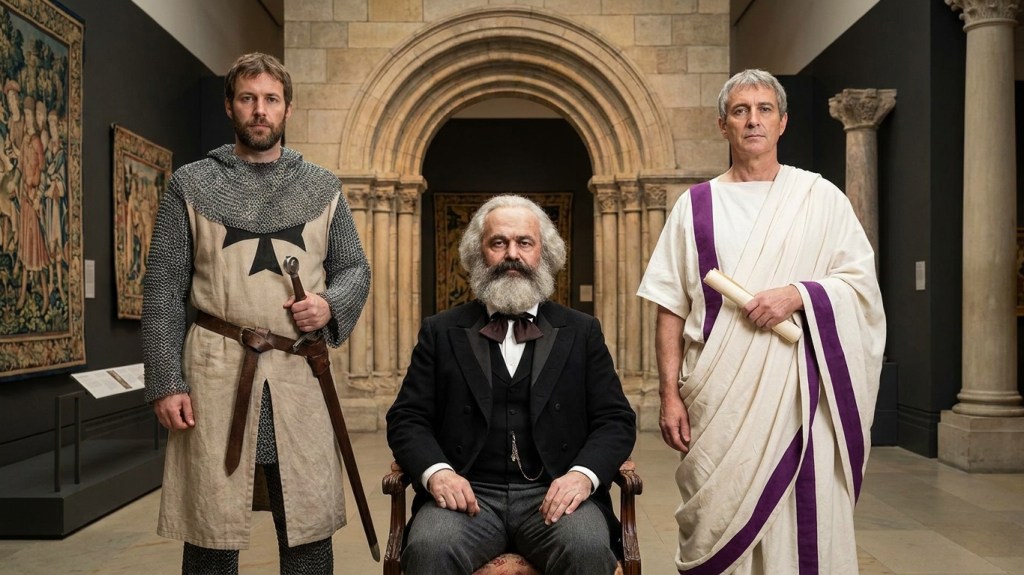
The next big phase in human history was the move from the Neolithic to the slave societies of the ancient world – or what we term, ‘civilisation’. The productive forces developed with a change from stone tools to metal tools – the rise of the Bronze Age. With that came the direct enslavement of people to work, with absolutely no rights, for the landowning elite.
This was not a peaceful transition – none of the changes from one form of society to the next were, according to Marx and his associate, Friedrich Engels. War captives were now branded, literally, as slaves. They had no future prospects and were worked until they died. The more fortunate might live in the master’s house as a tutor or servant while the rest were treated as a form of livestock on farms, mines, and in quarries.
Civilisation, Engels noted, marked the final collapse of any hint of egalitarianism with the intertwining of both class and patriarchy, driving women into a subservient role.
The slave societies gave way to feudalism in what we term the early Middle Ages. Why did this happen? To Marx and Engels, each form of society initially advances the means of production but then becomes a barrier to further growth. The internal ‘contradictions’ overwhelm the social class in control leading to a rupture and new social relations.
With the ancient slave states, the direct bodily ownership of workers was incredibly inefficient. Far better to tie people to the land than to the master. Otherwise, the owner is liable for any injuries sustained during work. Also, the main supply of slaves was through constant imperial expansion, which was costly and not always possible.
The Roman Republic had been founded by farmers with smallholdings who were driven off their land by the senatorial aristocracy who replaced them with mega-estates worked by slaves. But by the end of the Roman Empire, it made far more sense to create a class of tenant farmers – proto-serfs – who were self-sufficient to a degree but also obliged to create a surplus for the local lord. And so we got medieval feudalism.
Yet again then, in Marx’s theory of historical materialism, we get those inner contradictions between the way a society produces goods (means of production) and how it organises production (the relations of production = class structure). There’s also a dialectical process underlying all this. Feudalism is a positive compared to slave societies but then becomes a negative compared to emergent capitalism resulting in the new supplanting the old. Thesis – antithesis – synthesis.
Feudalism was focussed on agriculture. As a new capitalist class or traders and merchants grew, its demands clashed with the requirements of the old order.
Marx and Engels saw society as resting on an economic base of the forces and relations of production. On top of that sits a ‘superstructure’ of political organisations, legal bodies, ideology, and culture. Capitalism began to transform the economic base of society, which then clashed with the feudal superstructure. Eventually, the capitalist class – the bourgeoisie – had to sweep away the remnants of the feudal superstructure in order to operate without arcane obstacles.
The English Civil War and French Revolutions can be viewed as bourgeois uprisings. Though people at the time didn’t necessarily view what they were doing in such terms. Due to what Marx and Engels termed ‘false consciousness’, they saw their fight as something framed in biblical or purely legal terms. But the end result was a decisive step from feudalism to capitalism.
The peasantry was forced off the land and into the growing cities, where it eventually became the industrial working class. A new wave of global colonialism, the African slave trade, and unprecedented levels of commerce let the capitalists accumulate a surplus that would have been beyond the imagination of a Neolithic king or priest.
What often surprises people learning about Marxism for the first time is the enthusiasm displayed by Marx and Engels for the bourgeois revolutions that ended feudalism. Written during a year of revolution in 1848, The Communist Manifesto can come across as a hymn of praise to bourgeois radicals who were sweeping away the last vestiges of kings and princes. Yet again, this is Marx making it clear that these stages of human development were unavoidable but heralded something better in the future.
Which brings us to Das Kapital – Marx’s magisterial critique of capitalism – and other works. For the record, Marx doesn’t supply much detail about what the next communist phase of society will look like but does outline why capitalism is increasingly bedevilled by its own inner contradictions.
As ever, these are the contradictions between the productive forces and the social relations. Marx is not just saying that capitalism is evil because workers don’t control their own factories. He is suggesting that the system – regardless of moral iniquity – can’t continue. It’s a machine that has fatal flaws.
This includes a tendency for the rate of capitalist profit to fall – something that capitalists struggle to contain. Competition forces them to invest in new technology that lowers their production costs (constant capital) at the expense of human labour (variable capital). But because, in Marx’s view, it’s human labour that is the basis for profit creation, this reduces the rate of profit making it harder for capital to expand.
Then there is the crisis of overproduction. In a nutshell, capitalists maximise profits by reducing the wage bill. But then workers as consumers provide a shrinking market that can’t buy back what it’s produced. This leads to overproduction, or underconsumption – depending on which end of the economic telescope you are looking.
Capital concentrates driving middling businesses down into the working class and sharpening division within society. It also creates an obscene wealth gap that is ultimately de-stabilising. Plus we have a generalised accumulation of misery among workers as they are steadily impoverished and bitterly aware of being divorced from their own labour. All of this combined creates a climate for revolution.
Put simply, historical materialism is about repeat blockages that impede human development and need to be removed – often violently. Interestingly, Marx and later Marxists were at pains to point out that socialism, regardless of removing social class, might throw up a whole new set of challenges for humanity. But it would have removed that antagonism between the productive forces and social relations.
Categories: History
 Marxism Explained
Leave a comment