
How did one of the greatest civilisations in history – the Roman Empire – rise and fall? It’s a question that has vexed historians for centuries. The majestic ruins of ancient Rome are visible across Europe and the Middle East – evidence of this once seemingly invincible force. Yet the empire collapsed. Can the precipitous rise and ultimate destruction of the Roman Empire be explained in Marxist terms?
The Rise of the Roman Empire – from a Marxist perspective
The Roman Empire emerged with the end of the Roman Republic, which was the system of government that saw Rome go from a minor city state to a Mediterranean giant over a four century period from around 509 BC to 27 BC. The republic’s fall is explained in non-Marxist analyses as being due to the emergence of powerful generals, the increasing role of the army, and the idea that only a dictatorship could manage such a vast geographical area.
This version of events was fictionalised by the Star Wars franchise – projected into a mythical future. We have the end of the Galactic Republic and the rise of evil Palpatine, for which read Julius or Augustus Caesar. To the non-Marxist, the republic’s demise was an institutional failure as well as the result of megalomaniac personalities and bitter faction fighting.
But this narrative doesn’t suffice for a Marxist. The primary focus must always be on the economic base and the relations of production. Underlying the shift from republic to empire was a fundamental change from an economy based on small-scale farming to large estates worked by slaves.
The conservative faction in Rome’s senate – the Optimates – recognised that the wiping out of the citizen-farmer class was eradicating the social base of the republic. A slave, after all, had no stake in the system whereas a peasant farmer with a smallholding did.
However, Optimates did nothing to resolve the situation as they were benefitting financially from gobbling up smaller estates and enriching themselves. In opposition to them, the Populares, who were also wealthy senators in their own right, tried to slow down or even reverse the process. They could see the problems ahead – especially when it came to replenishing Rome’s armed forces.
The peasant farmer had traditionally felt incentivised to lay down their plough and take up the sword to protect their precious land from Rome’s enemies. However, these soldiers then spent a long time away – and at greater distances as the republic expanded. They fell into debt – with punishing rates of interest – and were forced to sell up to bigger landowners.
These landowners in the senatorial class used the cheap and plentiful supply of slaves being taken prisoner in Rome’s wars to work their estates. Meanwhile, the now landless peasantry moved into the cities, living in wretched slums, where the Populare faction in the senate whipped them into a frenzy against their opponents. They became a mob that could be bought and deployed by cynical politicians.
There were attempts to address the problems created by this change in social relations. Gaius Marius, a Populare, saw that the traditional militia system for the army, based on small property holders, was dead. So, he professionalised the army by enrolling landless citizens, removing the property requirement, and with the state providing their equipment and other essentials.
More radically, the Gracchi brothers – Tiberius and Gaius – tried to redistribute land back from wealthy elites to the landless poor. Despite their best efforts, the senate resisted and both men were murdered.
To Marx, the eradication of the small-holding peasantry removed the social base for the Roman Republic, the ‘superstructure’ that sat on the economic base. The slave mode of production allowed the empire to expand rapidly by pooling involuntary labour on to huge estates, quarries, mines, and in all aspects of urban life. But this plus eventually became a minus.
The Fall of the Roman Empire – from a Marxist perspective
When explaining how capitalism will end, Marx described the working-class – the proletariat – as the nemesis of the capitalist class, which had created it. But the fall of Rome is not the result of a vast slave uprising. In fact, Roman history is very much characterised by the absence of such an event. It appears that slaves were largely passive and resigned to their servitude.
However – that’s not entirely true.
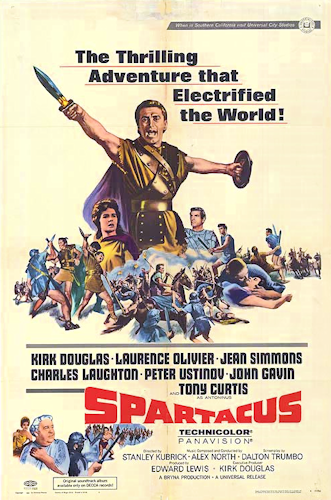
During the Roman Republic, between 135 BC and 71 BC, there were three so-called Servile Wars. The first two less well known wars were in Sicily, where slaves rose up over their ill treatment. The third war, on the Italian mainland, was led by Spartacus – whose name has resonated down the centuries. In 1960, he was depicted by the Hollywood actor Kirk Douglas in director Stanley Kubrick’s epic movie titled Spartacus.
But…his rebellion was an abject failure and signalled the end of large scale slave disobedience. Sure, there were bandits and pirates in the imperial period, but the slaves were mostly cowed. Why?
Marxists have explained this by arguing that slaves were incapable of organising along class lines and lacked any notion of class consciousness. They engaged in low-level, individual acts of resistance, but the idea of forming a revolutionary party was not going to happen at this stage of history.
In addition, it’s important to point out that slavery was not the only form of labour in the Roman Empire. There were still peasant smallholders, tenants, wage labourers, and skilled artisans. Most of these people were ‘freemen’ – non-slaves who might be comfortably off or achingly poor.
Why didn’t the free poor and slaves join up to overthrow the rich?
The reality is they didn’t recognise any identity of interest. The free poor viewed slaves as competition for work and they were kept from starving by state handouts of bread as well as entertainment in the arena (‘bread and circuses’). Slaves were locked into a system known as ‘manumission’ where they saved whatever money they could make on the side to buy their freedom. So, they were invested in the system.
There may have been slave uprisings that were not recorded or have been forgotten. The Roman state undoubtedly deployed horrific levels of violence to keep slaves in place. In 10 CE, the senate passed a truly Machiavellian piece of legislation: the Senatusconsultum Silanianum (Silanian Decree of the Senate). It stipulated that if the master of a household was murdered, all slaves under that same roof could be tortured and executed.
For slaves, the situation was truly hopeless. Plus there was no alternative mode of production that offered a path out of slavery. Even Spartacus just reversed the master-slave relationship. This turning upside down of the natural order was even done in jest during the annual festival of Saturnalia where Roman slaveowners pretended to be slaves – for a laugh.
Marx often writes about the internal contradictions that bring a socio-economic system to its knees – where the social relations of class hold back the underlying forces of production. And so, the Roman Empire proved to be a classic case in point. The fall was occasioned more by internal collapse than a revolutionary overthrow.
The ‘barbarians’, by the way, cannot be viewed as a revolutionary class. The agent of revolutionary change normally comes from within the society to be transformed. In addition, the tribes that overwhelmed the western half of the Roman Empire were slave-based societies to differing degrees. And when the goths took over Italy in the 5th century CE, they were at pains to prolong the structure of Roman society – simply placing themselves at the top.
Rome had been in decline from the 2nd century CE. The empire showed occasional signs of recovery but the overall trajectory was downwards. Key factors include the low productivity and lack of technical innovation inherent in a slave society – why bother improve machinery when you have an ample supply of ‘tools that talk’ (an actual Roman term for slaves).
As the empire stopped expanding, the slave supply came under pressure. The Romans addressed this problem by encouraging reproduction from within the slave class. Varro, a Roman author, even wrote about slave breeding as if he was describing cattle. Plus there were always people selling themselves into slavery because of debt; slaves could be imported as a financial transaction; and abandoned babies were reared as slaves.
But in truth, slaves became more expensive. This made the great estates of the wealthy increasingly unviable. How to resolve this problem? Over a long period of time, there was a shift from the traditional slave-based social relations on the land to something termed the ‘coloni’.
To a casual observer, the coloni bear a close resemblance to slaves but there were important differences. They were free – but not free to move. A series of laws from the emperor Diocletian in the 290s CE to his successors in the third century CE forced coloni to stay put – on the land allocated to them. The emperor Constantine made the status of coloni hereditary in 332 CE and those who fled would be treated like runaway slaves – chained to the spot.
So, what on earth is the difference between a coloni and a slave? To summarise, the coloni was a legal person, though with very limited rights, while the slave had no legal standing – in fact, a slave was barely human. A coloni was tied to the land while a slave could be sold separately. In fact, if a landowner sold an estate, it came with the coloni – but not the slaves. A coloni could marry and own property (with the landowner’s approval) but the slave could not.
The coloni paid rent in produce or money. This made them a dependant class of agricultural labourers but not slaves, owned bodily by the landowner, which had clear advantages for the rich. An injured slave needed to be repaired like a physical object you own. But a ‘coloni’ could go and sort himself out.
The barbarians may have accelerated this process. When they were settled within the empire in the 4th and 5th centuries CE, they became increasingly self-governing, creating heavily militarised communities of Frankish, Visigoth, and Burgundian farmers. The Roman state developed, out of necessity, a more arms-length relationship with these settlers, extracting revenue but allowing them to farm on their own terms.
It’s not difficult to see what’s happening here. We are getting the first green shoots of medieval feudalism. Here’s a description in one Marxist text:
“Elements of feudalism, as has already been said, had originated in the womb of slave-owning society in the form of the system of coloni. The coloni were obliged to work the land of their master, the large landowner, to make him a definite money payment or hand over a considerable share of the harvest, and to fulfil various types of duty. Nevertheless, the coloni had more interest in their labour than the slaves, since they had their own holdings.”
Basically, slavery didn’t work anymore. However, it’s important not to embrace a ‘vulgar Marxist’ analysis here where slavery vanished in a puff of smoke as the Roman Empire fell. In fact, there were thriving slave markets into the early Middle Ages run by the Vikings, Venice, and in the Islamic caliphate. Around 10% of England’s population are listed as slaves in the Domesday Book of 1086 CE.
Nevertheless, with Rome’s fall – the era of slavery gave way to feudalism – the next stage of human exploitation.
Categories: History
 Marxism Explained
Leave a comment